





For safety's sake, Lexus will include a Tire Pressure Monitoring System (TPM) that will detect and let the driver know when one or more tires have lost air pressure, by way of a warning light on the dash. It's important to regularly check tire pressure as either too much or too little could cause early tire wear that could inevitably result in an accident. Tire pressure that's too low could do the same. As most people don't check their tire pressure very often, an automatic system such as that offered in the GS could actually save lives.
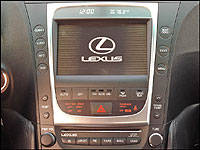 |
| The car's back-up camera is integrated into the navigation display, which also does multiple-duty as the infotainment system controller. (Photo: Lexus) |
The same could be said for the new car's Adaptive Front lighting System (AFS), which literally bends toward curves, lighting what would otherwise be a dark road ahead as the steering wheel turns.
The car's back-up camera effectively does the same thing, day or night. The current LS and RX makes use of this system, both of which I've tested. Now you can have no worries about running over your child's bicycle, or more importantly your child when backing out of your driveway. The screen is integrated into the navigation display, which also does multiple-duty as the car's infotainment system controller.
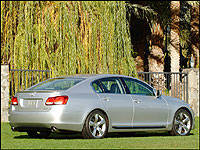 |
| The next-generation GS will get knee airbags for front occupants, plus standard front and rear side curtain airbags. (Photo: Lexus) |
Big Brother opponents might initially get spooked by the new model's optional Pre-Collision System (PCS), which acts on behalf of the driver to apply emergency braking and prepare the car for a crash. But not to worry, the system merely makes use of a millimeter-wave radar sensor to detect obstacles in front before signaling a pre-collision system computer with variables such as vehicle speed, steering angle and yaw rate inputs, which in the end decides whether a collision is unavoidable. Once a digital decision is made the system preemptively retracts front seat belts and applies Brake Assist to reduce the speed of impact. While it sounds complicated, it's one of those technologies that you don't have to read the manual beforehand to initiate. It will go about its business all on its own, without any input from the driver.