





The reason for the Q7's late arrival to the premium sport utility market can be pinpointed to upper management's inability to decide which platform it should
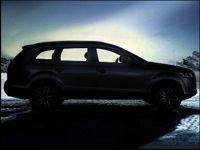 |
| The Q7 will indeed be related to the Touareg and Cayenne, however, its wheelbase has been stretched by 6.57 inches allowing enough space to incorporate a third row with adequate legroom. (Photo: Audi of America) |
One goal that Audi set out to achieve was making the Q7 the largest premium sport utility vehicle on the market. At 200.2 inches long, 78.0 inches wide, 68.4 inches high and 118.2 inches in wheelbase, the Q7 not only casts a shadow over the Touareg and Cayenne, but key rivals from BMW and
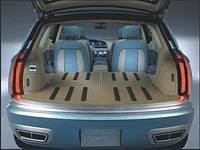 |
| When used as a five-seater, as most owners will, the Q7 (Pikes Peak Concept shown) can carry a class-leading 27.4 cu ft of gear, and when second and third row are stowed away a gargantuan 71.9 cu ft becomes available. (Photo: Audi of America) |
With all that extra space and three rows of seating, the Q7 just might be the most practical premium sport utility vehicle on the market. Audi claims that no less than 28 different seating and loading combinations can be made, a figure that shames most modern minivans. With clever packaging including second and third row seating which folds flat into the floor, luggage space is never at a premium. When used as a five-seater, as most owners will, the Q7 can carry a class-leading 27.4 cubic feet of gear, and when second and third row are stowed away a gargantuan 71.9 cubic feet becomes available.