





And while bigger (but ever-shrinking) GM, and a downsizing Ford often get
lumped into the same discussion when describing what's wrong with the North American auto industry on the whole, their problems, at least when it comes to the products currently being offered, are very different.
The world's largest automaker, largest at least until Japanese giant Toyota takes the lead sometime in the year future, is plagued with too many powertrain combinations driving too many different models being sold by too many different brands through too many independent dealers, which of course adds tremendous cost to what could otherwise be a much simpler lineup. Ford, on the other hand, hasn't given its buyers enough model and drivetrain choices, especially in its midsize car and crossover range. Up until recently it only offered potential buyers the stale-dated Taurus and well executed but somewhat bland looking Five Hundred in the sedan range, plus the impressive and, fortunately for Ford, extremely well received aforementioned Freestyle in the CUV segment. With only a single V6 available for all models, from entry-level blue-oval midsize vehicles to upscale Lincolns and Jaguars, the Duratec 30, an engine that's hardly new and not the most powerful in its various segments, is taxed beyond what most engines have to deliver.
Ford hopes to remedy this problem with its new Edge. Product launches aren't any more important for a carmaker, not only because
the stylish CUV is sure to attract the same younger, affluent buyer that are flocking to Ford showrooms to purchase its new Fusion sedan, but also because the debut marks the first new V6 engine since the Duratec 30 came to fruition, in 2.5-litre form, in the 1996 Contour, and then the following year in 3.0-litre guise under the hood of the Taurus - yes it's already a decade old.
So it's understandable why executives at Ford are getting a bit testy about their trusty old V6; not as much because of the engine itself but rather more so with every derogatory comment made by auto writers, ad nauseam, about it being underpowered and less refined than their beloved Accords and Camrys. Such execs, without doubt would rather us spout off the fact that it was the first domestic V6, and ahead of many
imports as well, with 24-valve, DOHC technology in the entry-level segment. So, while sophisticated V6 engines with variable valve timing and cylinder-deactivation are now showing up in the midsize market, it only makes sense that today's introduction of an all-new 3.5-litre V6 will be music to those same Ford executive's ears.
The new 3.5 boasts 250-horsepower at an estimated 6,250 rpm and 240 lb-ft of torque at 4,500 rpm, and comes mated to a front-drive configured in-house developed six-speed automatic - not the Aisin-derived six-speed auto currently used by the Five Hundred, Fusion, Mercury Montego and Lincoln Zephyr - but more on that in a minute. The engine is a 60-degree V, comprised of an aluminum block and heads, 4-valves per cylinder and DOHC technology, of course, plus intake variable camshaft timing.
"Our new 3.5-liter V6 is a key component in Ford's global powertrain strategy, which is to provide what customers want, when they want it," commented Barb Samardzich, Ford vice president of Powertrain Operations. "This powertrain is an innovative solution to answering the call for better fuel efficiency, more refinement, more power and clean emissions, without any sacrifices."
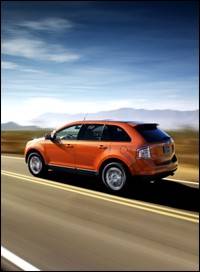 |
| Attractive styling makes all the difference in getting noticed. (Photo: Ford Motor Company of Canada) |
The world's largest automaker, largest at least until Japanese giant Toyota takes the lead sometime in the year future, is plagued with too many powertrain combinations driving too many different models being sold by too many different brands through too many independent dealers, which of course adds tremendous cost to what could otherwise be a much simpler lineup. Ford, on the other hand, hasn't given its buyers enough model and drivetrain choices, especially in its midsize car and crossover range. Up until recently it only offered potential buyers the stale-dated Taurus and well executed but somewhat bland looking Five Hundred in the sedan range, plus the impressive and, fortunately for Ford, extremely well received aforementioned Freestyle in the CUV segment. With only a single V6 available for all models, from entry-level blue-oval midsize vehicles to upscale Lincolns and Jaguars, the Duratec 30, an engine that's hardly new and not the most powerful in its various segments, is taxed beyond what most engines have to deliver.
Ford hopes to remedy this problem with its new Edge. Product launches aren't any more important for a carmaker, not only because
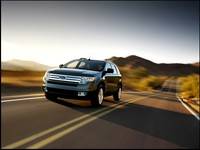 |
| Ford hopes to silent critics who don't find the current Duratec 30powerful enough, with the new 250-horsepower 3.5L V6 in the upcomingEdge. (Photo: Ford Motor Company of Canada) |
So it's understandable why executives at Ford are getting a bit testy about their trusty old V6; not as much because of the engine itself but rather more so with every derogatory comment made by auto writers, ad nauseam, about it being underpowered and less refined than their beloved Accords and Camrys. Such execs, without doubt would rather us spout off the fact that it was the first domestic V6, and ahead of many
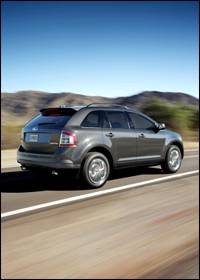 |
| "Our new 3.5-liter V6 is a key component in Ford's global powertrainstrategy..." commented Barb Samardzich, Ford VP of PowertrainOperations. (Photo: Ford Motor Company of Canada) |
The new 3.5 boasts 250-horsepower at an estimated 6,250 rpm and 240 lb-ft of torque at 4,500 rpm, and comes mated to a front-drive configured in-house developed six-speed automatic - not the Aisin-derived six-speed auto currently used by the Five Hundred, Fusion, Mercury Montego and Lincoln Zephyr - but more on that in a minute. The engine is a 60-degree V, comprised of an aluminum block and heads, 4-valves per cylinder and DOHC technology, of course, plus intake variable camshaft timing.
"Our new 3.5-liter V6 is a key component in Ford's global powertrain strategy, which is to provide what customers want, when they want it," commented Barb Samardzich, Ford vice president of Powertrain Operations. "This powertrain is an innovative solution to answering the call for better fuel efficiency, more refinement, more power and clean emissions, without any sacrifices."