





Misuno San was not only looking to build a lightweight car, but also a rigid, sturdy one. The team used aluminum, steel, carbon fiber and titanium in various strategic areas to increase rigidity. All outer body panels were stamped using a multiple-strike coining process for exceptional rigidity and precision.
Where do these 480 hp come from?
The answer: from the new 3.8L twin-turbo V6. This mill features an aluminum cylinder block with super-low-friction, high-endurance, plasma-sprayed bores (no more piston rings). Torque is rated at 430 lb-ft from 3,200 to 5,200 rpm. Each engine is perfectly balanced and handcrafted by its own master technician in a clean-room environment. Their performance is then rigorously evaluated and every single tool used during the assembly process is marked on the various engine components in order to be able to track them down and identify a culprit should a break or failure occur.
Six gears at your disposal
The transmission is also unique and hand-built: it's mounted behind the rear axle, thereby freeing up room for the cockpit. The narrow tunnel houses a carbon-composite driveshaft that sends power to the wheels. This transmission is a dual-clutch unit with no planetary gear set. It offers three driver-selectable settings: Off (auto), Normal and R-Mode. The latter allows shifts in 2 milliseconds via the paddle shifters on the steering wheel.
It's connected to a highly sophisticated ATTESA ET-S all-wheel drive system that also offers three settings: Normal, R-Mode and Snow. The system can transfer up to 50 percent of the available torque to the front wheels. There's no traditional clutch, so the Hill-Start Assist system helps prevent rollback when taking off on an incline.
Firmly planted
The fully independent suspension uses double wishbones in the front and a multilink setup in the back. The suspension subframes are assembled in high-precision jigs similar to a race car. Bilstein shocks with DampTronic technology are also found, again with three driver-selectable settings: Normal/Sport, R-Mode (for the track) and Comfort.
As for the rack-and-pinion steering, it's electronically controlled just like the throttle. In both cases, the operation is seamless. The steering wheel is precise and only requires 2.6 turns to go from lock to lock.
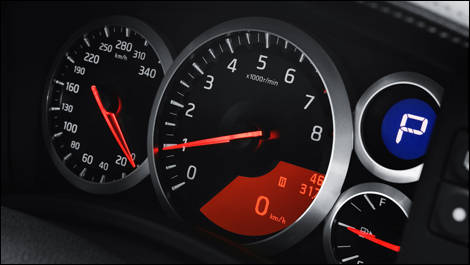 |
| The all-new hand-built 3.8-liter twin turbo V6 is producing 480 horsepower @ 6,400 rpm. |
Where do these 480 hp come from?
The answer: from the new 3.8L twin-turbo V6. This mill features an aluminum cylinder block with super-low-friction, high-endurance, plasma-sprayed bores (no more piston rings). Torque is rated at 430 lb-ft from 3,200 to 5,200 rpm. Each engine is perfectly balanced and handcrafted by its own master technician in a clean-room environment. Their performance is then rigorously evaluated and every single tool used during the assembly process is marked on the various engine components in order to be able to track them down and identify a culprit should a break or failure occur.
Six gears at your disposal
The transmission is also unique and hand-built: it's mounted behind the rear axle, thereby freeing up room for the cockpit. The narrow tunnel houses a carbon-composite driveshaft that sends power to the wheels. This transmission is a dual-clutch unit with no planetary gear set. It offers three driver-selectable settings: Off (auto), Normal and R-Mode. The latter allows shifts in 2 milliseconds via the paddle shifters on the steering wheel.
It's connected to a highly sophisticated ATTESA ET-S all-wheel drive system that also offers three settings: Normal, R-Mode and Snow. The system can transfer up to 50 percent of the available torque to the front wheels. There's no traditional clutch, so the Hill-Start Assist system helps prevent rollback when taking off on an incline.
Firmly planted
The fully independent suspension uses double wishbones in the front and a multilink setup in the back. The suspension subframes are assembled in high-precision jigs similar to a race car. Bilstein shocks with DampTronic technology are also found, again with three driver-selectable settings: Normal/Sport, R-Mode (for the track) and Comfort.
As for the rack-and-pinion steering, it's electronically controlled just like the throttle. In both cases, the operation is seamless. The steering wheel is precise and only requires 2.6 turns to go from lock to lock.
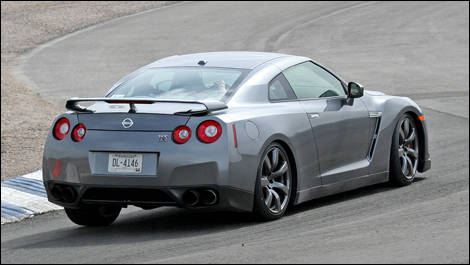 |
| GT-R chief engineer was not only looking to build a lightweight car, but also a rigid, sturdy one. |