





The S400’s hybrid arrangement is referred to in the industry as a “mild hybrid.” Mercedes-Benz has labeled it, “Blue Hybrid.” Irrespective of labeling, don’t expect the S400 to stealthily slither the streets solely on battery power despite its revolutionary lithium-ion battery pack.
The S400 relies upon the convergence of gas-derived power and that supplied electrically, which adds 20 horsepower and 118 pound-feet of torque to the output of a 3.5-litre V6 engine. The combined strengths culminate in 295 horsepower and 284 pound-feet of torque.
Power flows to the big sedan’s rear wheels, where it’s capable of knocking off 0-100km/h in just 7.2 seconds. A 7-speed G-TRONIC automatic transmission is credited in part with the sense of authority that’s appended to the right-foot.
Starts and stops
The Blue Hybrid technology shuts down the gas engine whenever the S400 comes to a stop. This process conserves fuel when the car is stationary. Once the driver’s foot departs the brake pedal, the engine instantly fires up.
For the most part, the shut down and restart phases are imperceptible unless creeping along in heavy traffic; the kind of traffic in which releasing the brake pedal allows the car to creep ahead a car length before having to stop again.
In this scenario, the V6 engine is constantly starting and stopping, which can become somewhat annoying. Of course, one need only be reminded that no money or pollutants are bleeding out the tailpipe during the shutdown phase.
Regenerative braking buys back power
As with other hybrid arrangements, the S400 recovers electrical energy through regenerative braking. This function tends to alter braking performance somewhat over conventional brake setups.
It’s hard to put into words but as with every hybrid I’ve ever tested, the S400’s brakes can grab at times while at other times they seem reluctant to bring the big sedan to a halt however adapting to regenerative braking simply takes a little time.
 |
| The convergence of gas-derived power and that supplied electrically which add 20 horsepower and 118 pound-feet of torque to the output of a 3.5-litre V6 engine. (Photo: Rob Rothwell/Auto123.com) |
The S400 relies upon the convergence of gas-derived power and that supplied electrically, which adds 20 horsepower and 118 pound-feet of torque to the output of a 3.5-litre V6 engine. The combined strengths culminate in 295 horsepower and 284 pound-feet of torque.
Power flows to the big sedan’s rear wheels, where it’s capable of knocking off 0-100km/h in just 7.2 seconds. A 7-speed G-TRONIC automatic transmission is credited in part with the sense of authority that’s appended to the right-foot.
Starts and stops
The Blue Hybrid technology shuts down the gas engine whenever the S400 comes to a stop. This process conserves fuel when the car is stationary. Once the driver’s foot departs the brake pedal, the engine instantly fires up.
For the most part, the shut down and restart phases are imperceptible unless creeping along in heavy traffic; the kind of traffic in which releasing the brake pedal allows the car to creep ahead a car length before having to stop again.
In this scenario, the V6 engine is constantly starting and stopping, which can become somewhat annoying. Of course, one need only be reminded that no money or pollutants are bleeding out the tailpipe during the shutdown phase.
Regenerative braking buys back power
As with other hybrid arrangements, the S400 recovers electrical energy through regenerative braking. This function tends to alter braking performance somewhat over conventional brake setups.
It’s hard to put into words but as with every hybrid I’ve ever tested, the S400’s brakes can grab at times while at other times they seem reluctant to bring the big sedan to a halt however adapting to regenerative braking simply takes a little time.
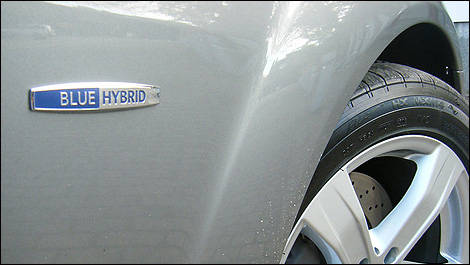 |
| The Blue Hybrid technology shuts down the gas engine whenever the S400 comes to a stop. (Photo: Rob Rothwell/Auto123.com) |