





The fear
We've all heard about the load that the EV movement might, could, will, bear down on the electricity grid. Unlike many places in the US, we in Canada have a rich supply of hydro electricity and other ways for creating "clean" energy. What we must remember is that our streets will not be flooded overnight with 1 million EVs sucking hard on our network. The effect will be gradual and with the help of governments and the forging of deals with energy providers such as the agreement Renault-Nissan struck with Reliant Energy of Houston Texas, the burden, if you will, will be a shared one.
There once was another form of fear, this time, carried by the group of people that will bring the EVs to the population; the acceptance of this type of transportation. 20 years ago, California may have been ready for the EV but I doubt that the remainder of North America would have greeted this technology with a smile. Back then, cheap oil was a deterrent to the development of EV technology. This is, as we know, no longer the case.
When asked if Nissan had any regrets about not being part of the "hybrid revolution", an employee of the company said that in a way, what Toyota, Honda and Ford have done is to pave the way for the EV. Had it not been for them and the success that their hybrids have garnered, Nissan may not have pushed the EV as hard as they have. They in fact created the "the-time-is-now" for a full-on EV car. This abated their fears. He added that now, Nissan is poised to leap-frog the others thanks to the LEAF.
A familiar trend
First note about the LEAF's styling is the fact that it is a four-door hatchback, exactly like the latest Toyota Prius and Honda Insight, both considered leaders in the hybrid game. So then, nothing new here. The LEAF is therefore aerodynamic, sleek and functional, all rolled into one. Numerous components in the car's outer-shell design exist for both form and function. The large headlight housings actually split and redirect wind away from the side-view mirrors, reducing drag and noise.
The overall shape of the LEAF borrows cues from a number of Nissan and Renault products. The car's hind quarters carry a mix of Megane and Clio while the roofline and rear-most pillar looks very Murano-like. In essence, what Nissan wanted was a unique car without the polarizing effect of a standalone special model like the original Prius and Insight. Job well done.
We've all heard about the load that the EV movement might, could, will, bear down on the electricity grid. Unlike many places in the US, we in Canada have a rich supply of hydro electricity and other ways for creating "clean" energy. What we must remember is that our streets will not be flooded overnight with 1 million EVs sucking hard on our network. The effect will be gradual and with the help of governments and the forging of deals with energy providers such as the agreement Renault-Nissan struck with Reliant Energy of Houston Texas, the burden, if you will, will be a shared one.
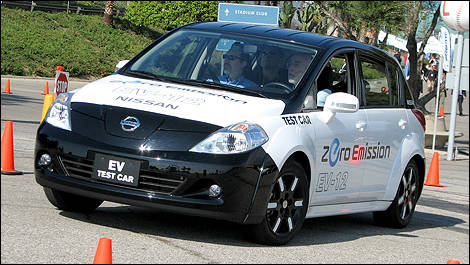 |
| We were told that the EV-12 is 95% a LEAF in technology, ride and handling. |
There once was another form of fear, this time, carried by the group of people that will bring the EVs to the population; the acceptance of this type of transportation. 20 years ago, California may have been ready for the EV but I doubt that the remainder of North America would have greeted this technology with a smile. Back then, cheap oil was a deterrent to the development of EV technology. This is, as we know, no longer the case.
When asked if Nissan had any regrets about not being part of the "hybrid revolution", an employee of the company said that in a way, what Toyota, Honda and Ford have done is to pave the way for the EV. Had it not been for them and the success that their hybrids have garnered, Nissan may not have pushed the EV as hard as they have. They in fact created the "the-time-is-now" for a full-on EV car. This abated their fears. He added that now, Nissan is poised to leap-frog the others thanks to the LEAF.
A familiar trend
First note about the LEAF's styling is the fact that it is a four-door hatchback, exactly like the latest Toyota Prius and Honda Insight, both considered leaders in the hybrid game. So then, nothing new here. The LEAF is therefore aerodynamic, sleek and functional, all rolled into one. Numerous components in the car's outer-shell design exist for both form and function. The large headlight housings actually split and redirect wind away from the side-view mirrors, reducing drag and noise.
The overall shape of the LEAF borrows cues from a number of Nissan and Renault products. The car's hind quarters carry a mix of Megane and Clio while the roofline and rear-most pillar looks very Murano-like. In essence, what Nissan wanted was a unique car without the polarizing effect of a standalone special model like the original Prius and Insight. Job well done.
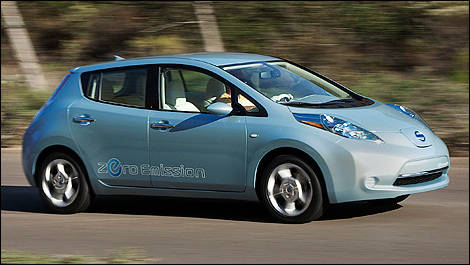 |
| The LEAF will use an electric engine that generates 80 kW (107 hp) and 280 nm of torque (206 lb-ft). |