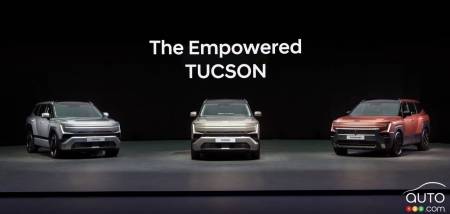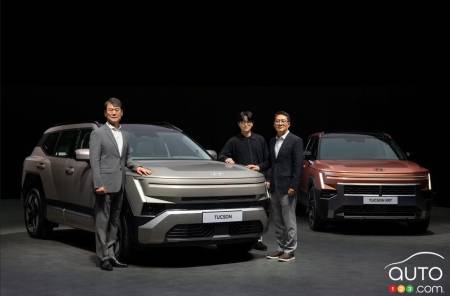



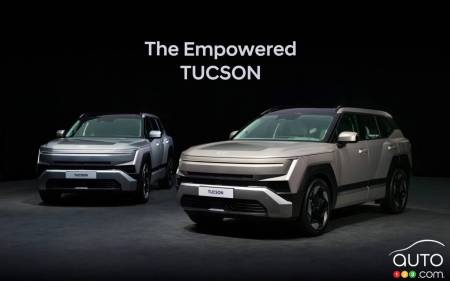
A month after teasing the first official images of its fifth-generation Tucson, Hyundai formally presented the all-new compact SUV during a media day at the CJ ENM Studio Center in Paju, South Korea. The new, in-person reveal sheds light on mechanical specs, interior technology, safety innovations and the ruggedized XRT variant.
The usual caveat applies here, in that this is for the version going to the South Korean market. Certain details may differ when the next Tucson debuts in Canada next year.
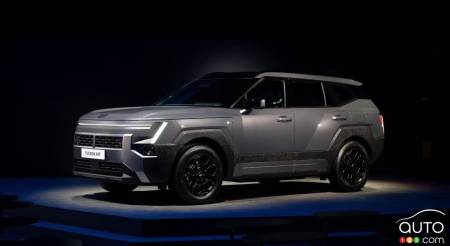
Design of the 2027 Hyundai Tucson
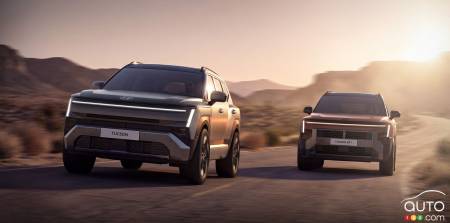
Embracing Hyundai's Art of Steel styling direction, the redesigned Tucson adopts a distinctly squarer, more athletic silhouette that brings it closer in spirit and in appearance to larger sibling the Santa Fe. At the front, H-shaped daytime running lights broaden the SUV’s visual stance, while three-dimensional prism tail lamps with transparent lenses yield distinctive lighting effects at the rear.
Boxier in shape it may be, but the new Tucson crossover slides through the air more efficiently, its maker promises. The coefficient of drag has dropped from 0.33 to 0.30, and that improvement comes thanks to active air flaps, aero-optimized 17-inch wheel designs, a resculpted roof spoiler and improved underbody sealing.
Eight exterior paint choices will be offered globally, including five fresh shades: Serenity White Pearl, Driftwood Gray Matte, Driftwood Gray Metallic, Red Rock Orange Matte and Quiet Copper Pearl.
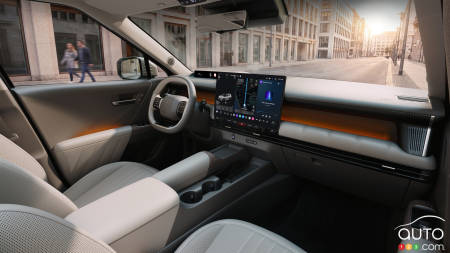
Interior of the 2027 Hyundai Tucson
We previously reported on the growth spurt experienced by the Tucson for this new generation. The SUV is 60 mm longer, with a 30 mm longer wheelbase, and 40 mm wider.
Beyond that, Hyundai has optimized the cabin for rear passengers. Rear headroom expands by 29 mm, while the rear door opening angle widens from 73° to 83° to make entry and exit effortless. Sound insulation has also been upgraded, featuring reinforced dashboard acoustic panels and thicker front-door glass to isolate wind and engine noise.
The redesigned cabin centres around a flattened steering wheel and a broad, ultra-wide digital cluster. The focal point remains a 12.9-inch or 17-inch central infotainment display running Hyundai's new Pleos Connect architecture. The platform integrates Gleo AI, a generative language model capable of contextual searches, interactive chats and intelligent route guidance.
Additional cabin highlights include a dual wireless smartphone charger, a 100 W ultra-fast USB port, first-row relaxation seats, an available Bang & Olufsen sound system and new two-tone interior colour schemes.
Powertrain of the 2027 Hyundai Tucson
It appears that Hyundai decided to move away from Tucson’s naturally aspirated 2.5L engine. For the South Korean market at least, entry-level variants feature a 1.6L turbocharged engine generating 190 hp and 195 lb-ft of torque, now paired with an 8-speed automatic transmission rather than a dual-clutch setup.
The Tucson Hybrid receives a next-generation powertrain delivering a combined 242 hp (up from 231). Targeted fuel efficiency improves to an estimated 5.7L/100 km. Hybrid models feature Hyundai's E-Traction technology, which uses the electric motor to manage vehicle pitching and roll, ensuring stable handling across uneven road surfaces.
Details on the plug-in hybrid (PHEV) remain under wraps, so nothing to report there.
Safety tech in the 2027 Hyundai Tucson
The new Tucson debuts a segment-first backup power door unlocking system, ensuring occupants can exit the vehicle quickly in emergencies even if main battery power is severed after an impact. It also introduces a pedal misapplication safety system that limits acceleration and applies the brakes if the driver accidentally depresses the accelerator instead of the brake pedal.
A rugged XRT trim
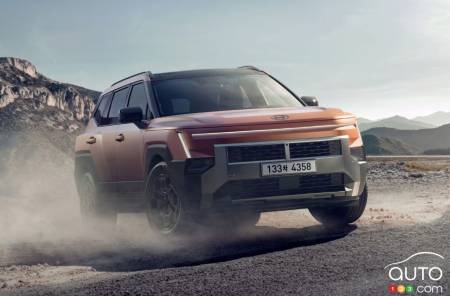
For buyers seeking a tougher appearance – and the market certainly features a lot of those at the moment - the XRT variant returns with an aggressive split grille, model-specific front and rear bumpers, dark skid plates, forged-carbon-patterned lower body cladding, dark metal interior trim and unique patterned seating.
Note that for the moment, this is pretty strictly an aesthetic package and doesn’t enhance performance or off-road capabilities. The true off-roading XRT Pro variants being considered by Hyundai for this and other models remain, for the moment, just that: a consideration.
The fifth-generation Tucson launches in South Korea next month, with global rollouts following. We can expect the new model to arrive in Canada, likely as a 2028 vintage.