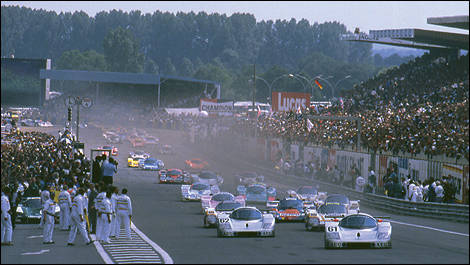
With the lustre of the World Sports Car Championship beginning to fade, Mercedes set its sights on Formula One and, in summer 1991, F1 was declared a joint project. Preparations hit full swing and Sauber built a new factory at its premises in Hinwil.
 |
| Photo: Sauber |
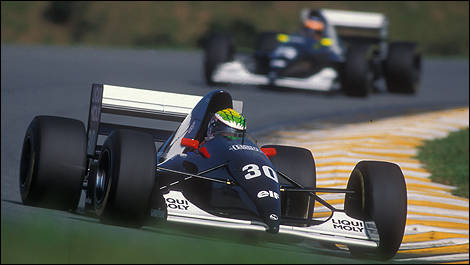
However, bad news was on its way that November. The challenging economic climate at the time caused the Mercedes Board of Management to decide not to enter Formula One with a works team. Sauber was left with two options: pocket the financial settlement and turn its back on racing or use it as start-up capital for its own grand prix operation. In January 1992 Sauber decided to take the plunge, and in autumn that year the C12 completed its first testing session, an Ilmor engine providing the power. By that time the company was employing just under 70 people.
 |
| Photo: Sauber |
Graduating to Formula 1On 14th March 1993, two Sauber C12 racers - piloted by Karl Wendlinger and JJ Lehto - lined up, as planned, on the grid at Kyalami for the South African Grand Prix. The two World Championship points earned by Finnish driver Lehto for fifth place in the race ensured the team's debut was a widely acclaimed success. Contracts signed with Red Bull and Petronas in 1995 gave the Swiss team a solid foundation and allowed it to establish itself as a fixture in Formula One. In 1995 and 1996 Sauber served as the Ford works team, and from 1997 the cars were powered by Ferrari engines and carried the name of title sponsor Petronas.
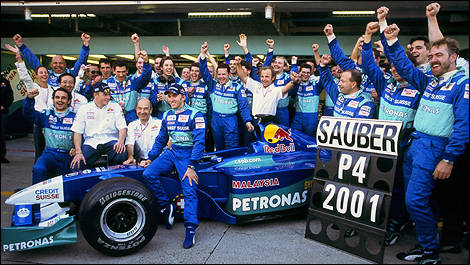
However, the crucial breakthrough remained elusive. That was until 2001, when three milestones in the team's history arrived in quick succession: the partnership with major Swiss bank Credit Suisse, a fourth-place finish in the F1 Constructors' World Championship in mid-October and, just a few days later, the groundbreaking ceremony for the team's own wind tunnel.
 |
| Photo: Sauber |