





This was however not the reason for this particular design and configuration, which was rather attributable to the assembly process at the time, with the crankshaft being completely pre-assembled together with the connecting rods and pistons. And since the pistons, as a result, had to be inserted from beneath, the main bearings for the crankshaft had to remain outside of the cylinders, not extending into their contour lines. As a result, the main bearings had to be accommodated between cylinders spaced out at a large distance.
While this power unit delivered maximum output of 34 hp on the saloon with its two carburettors, maximum output of the six-cylinder in the BMW 315/1 sports model was 40 hp. And the standard of efficiency offered was quite exceptional, BMW’s engineers proudly stating that “this beautiful and fast sports car consumes only 10–2 litres of fuel on 100 km, with oil consumption between 0.1 and 0.2 kg. So in terms of running costs, it is no more expensive than a small car far lower down in the market”.
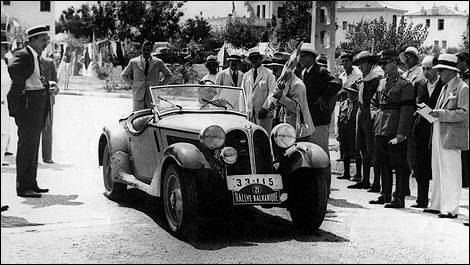
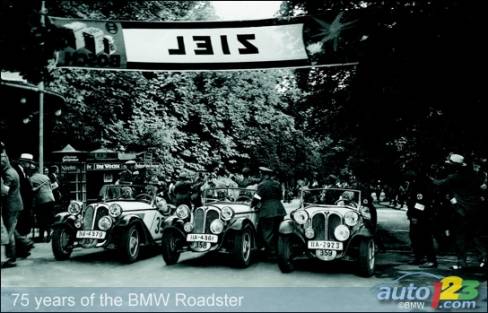
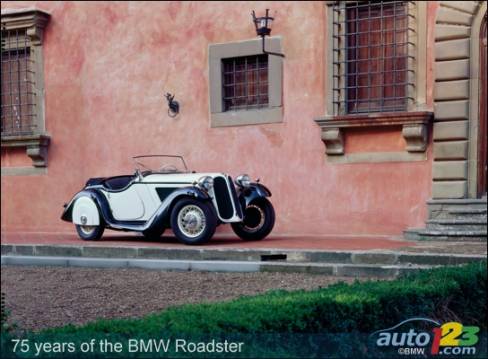
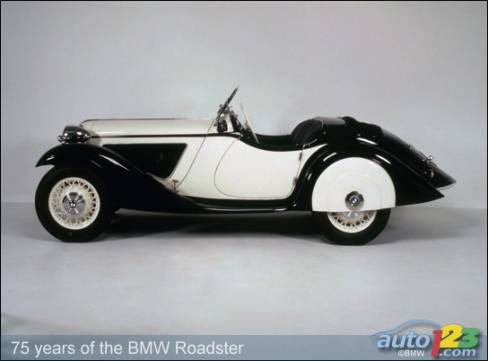
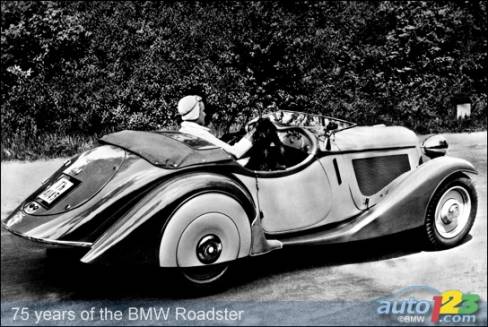
With the public simply falling in love with the BMW 315/1, BMW decided to build the car in a small series – also because the Company wanted to make a more powerful entry into the prestigious world of motorsport. Starting in summer 1934, therefore, the very attractive BMW 315/1 was retailed at a substantial 5,200.– reichsmarks. The production model differed from the prototype primarily through the modified arrangement of the headlights and side ventilation grids taking the place of the bent openings originally featured on the first model.
n unmistakable athlete to this day: the BMW Z4
The latest member of the BMW roadster family is the BMW Z4 presented for the first time at the Paris Motor Show in September 2002. From the start, this open two-seater not only marked a further highlight in BMW design language, but also set new standards in its class. The exciting design of the car was determined by the highly attractive interplay of convex and concave surfaces, hard edges and smooth, sweeping curves.
Available from the start with a choice of two high-torque straight-six power units, the Z4 – either in the guise of the 231-hp Z4 3.0i or as the 192-hp Z4 2.5i – guaranteed roadster motoring at its best.
The outstanding agility of the BMW Z4 is ensured by the car’s wide track, an extremely low centre of gravity, optimum 50:50 axle load distribution, and the very precise electric power steering. Fading-free high-performance brakes, runflat tyres featured as standard, and Dynamic Stability Control (DSC III) with an add-on traction mode finally, guaranteed supreme driving safety under all conditions.
Style and performance: the new BMW Z4
The modern interpretation of the classic roadster launched in spring 2009, the new BMW Z4, combines more power with more style than ever before. Indeed, this is the only car in its segment to combine classic roadster proportions with the seating position moved far back close to the rear axle, rear-wheel drive and a fully automatic retractable hardtop.
The new BMW Z4 offers all the driving pleasure of a BMW roadster in particularly refined style. Driving with the roof down, this outstanding two-seater provides a refreshing experience of the sun shining in and the wind rushing by, with the hardtop closed it ensures the same level of all-round comfort as a sporting coupé in the premium segment. So through its wide range of diverse qualities alone, the new BMW Z4 is indeed the re-birth of the roadster.
Here again, it is certainly appropriate to quote the “BMW Blätter”, the original BMW Leaflets in their description of the BMW 315/1 back in 1934: “In a nutshell you can describe BMW’s new sports car as the fast, beautiful and reliable car bound to give the ambitious sports driver one exhilarating experience after the other, at the same time combining all the advantages of an economical touring car.”
While this power unit delivered maximum output of 34 hp on the saloon with its two carburettors, maximum output of the six-cylinder in the BMW 315/1 sports model was 40 hp. And the standard of efficiency offered was quite exceptional, BMW’s engineers proudly stating that “this beautiful and fast sports car consumes only 10–2 litres of fuel on 100 km, with oil consumption between 0.1 and 0.2 kg. So in terms of running costs, it is no more expensive than a small car far lower down in the market”.
With the public simply falling in love with the BMW 315/1, BMW decided to build the car in a small series – also because the Company wanted to make a more powerful entry into the prestigious world of motorsport. Starting in summer 1934, therefore, the very attractive BMW 315/1 was retailed at a substantial 5,200.– reichsmarks. The production model differed from the prototype primarily through the modified arrangement of the headlights and side ventilation grids taking the place of the bent openings originally featured on the first model.
 |
n unmistakable athlete to this day: the BMW Z4
The latest member of the BMW roadster family is the BMW Z4 presented for the first time at the Paris Motor Show in September 2002. From the start, this open two-seater not only marked a further highlight in BMW design language, but also set new standards in its class. The exciting design of the car was determined by the highly attractive interplay of convex and concave surfaces, hard edges and smooth, sweeping curves.
Available from the start with a choice of two high-torque straight-six power units, the Z4 – either in the guise of the 231-hp Z4 3.0i or as the 192-hp Z4 2.5i – guaranteed roadster motoring at its best.
The outstanding agility of the BMW Z4 is ensured by the car’s wide track, an extremely low centre of gravity, optimum 50:50 axle load distribution, and the very precise electric power steering. Fading-free high-performance brakes, runflat tyres featured as standard, and Dynamic Stability Control (DSC III) with an add-on traction mode finally, guaranteed supreme driving safety under all conditions.
Style and performance: the new BMW Z4
The modern interpretation of the classic roadster launched in spring 2009, the new BMW Z4, combines more power with more style than ever before. Indeed, this is the only car in its segment to combine classic roadster proportions with the seating position moved far back close to the rear axle, rear-wheel drive and a fully automatic retractable hardtop.
The new BMW Z4 offers all the driving pleasure of a BMW roadster in particularly refined style. Driving with the roof down, this outstanding two-seater provides a refreshing experience of the sun shining in and the wind rushing by, with the hardtop closed it ensures the same level of all-round comfort as a sporting coupé in the premium segment. So through its wide range of diverse qualities alone, the new BMW Z4 is indeed the re-birth of the roadster.
Here again, it is certainly appropriate to quote the “BMW Blätter”, the original BMW Leaflets in their description of the BMW 315/1 back in 1934: “In a nutshell you can describe BMW’s new sports car as the fast, beautiful and reliable car bound to give the ambitious sports driver one exhilarating experience after the other, at the same time combining all the advantages of an economical touring car.”
Article Gallery