





Ford is currently working with the Center for Compact and Efficient Fluid Power (CCEFP) on the development of an F-150 with a fuel efficiency rating of 5.88 litres per 100 km and still powered by the 4.6-litre V8. How is that possible, you may ask? Well, the answer lies with hydraulic hybrid powertrains.
The system differs from gas-electric hybrids in that the batteries are replaced by a tank that stores fluid that has been pressurized by an accumulator, acting as a secondary energy source and working hand in hand with the internal combustion V8.
The pressure is converted into energy that is sent to the rear wheels via a CVT, which adds two hydraulic pump-motors connected by a planetary gear set.
Perri Li, co-deputy director of CCEFP and professor of mechanical engineering, explains: “The combined fuel consumption of the F-150 is around 16 to 18 mpg (13-14 L / 100 km). By adding the CVT, we believe it will be above 20 mpg. When we add the hydraulic hybrid system, there’s the potential to reach 40 mpg or higher in urban driving. The gain is not as much as on the highway, but it’s significantly better”.
Less fuel is burned in the city, because the F-150’s hydraulic system uses the energy usually lost during braking to recharge the accumulator, a process that has already been adopted by most hybrid and electric vehicles.
Take for example a contractor who has to haul loads and make frequent stops and starts on a worksite, which is what most truck owners do. Hydraulic hybrids clearly show enormous potential here.
However, we shouldn’t necessarily expect to see Ford products benefiting from the new technology in the near future. A company named Eaton has already created a similar system for its delivery and dump trucks, but it turned out to be rather costly and complex and so wasn’t as successful as they’d hoped.
That’s why CCEFP is working with a variety of partners to improve the system and ensure it’s both economically viable and durable for manufacturers. Will we one day see F-150s sipping as little as sub-compact or electric models? To be continued…
Source: PickupTrucks
The system differs from gas-electric hybrids in that the batteries are replaced by a tank that stores fluid that has been pressurized by an accumulator, acting as a secondary energy source and working hand in hand with the internal combustion V8.
The pressure is converted into energy that is sent to the rear wheels via a CVT, which adds two hydraulic pump-motors connected by a planetary gear set.
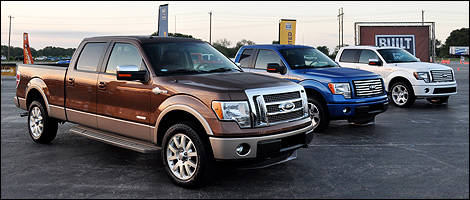 |
| Photo: Mathieu St-Pierre/Auto123.com |
Perri Li, co-deputy director of CCEFP and professor of mechanical engineering, explains: “The combined fuel consumption of the F-150 is around 16 to 18 mpg (13-14 L / 100 km). By adding the CVT, we believe it will be above 20 mpg. When we add the hydraulic hybrid system, there’s the potential to reach 40 mpg or higher in urban driving. The gain is not as much as on the highway, but it’s significantly better”.
Less fuel is burned in the city, because the F-150’s hydraulic system uses the energy usually lost during braking to recharge the accumulator, a process that has already been adopted by most hybrid and electric vehicles.
Take for example a contractor who has to haul loads and make frequent stops and starts on a worksite, which is what most truck owners do. Hydraulic hybrids clearly show enormous potential here.
However, we shouldn’t necessarily expect to see Ford products benefiting from the new technology in the near future. A company named Eaton has already created a similar system for its delivery and dump trucks, but it turned out to be rather costly and complex and so wasn’t as successful as they’d hoped.
That’s why CCEFP is working with a variety of partners to improve the system and ensure it’s both economically viable and durable for manufacturers. Will we one day see F-150s sipping as little as sub-compact or electric models? To be continued…
Source: PickupTrucks