





More integral to constant growth is the middle income earner boom, driven in part by the new auto sector. Foreign automakers have invested more than USD$30 billion into China since the country opened up to outside investment in the early '80s.
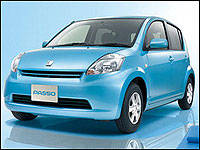 |
| Toyota and Daihatsu introduced the two company's cooperative effort in the compact segment, the Passo and Boon respectively. Both cars will be available in China through each brand's dealer network. (Photo: Toyota) |
China was smart in forcing foreign carmakers to joint venture with Chinese partners, allowing knowledge and expertise to bolster local operations and make them more competitive in their own market. The best example of joint venture success may be Volkswagen's Santana sedan, said to be one of the most popular new cars in the country.
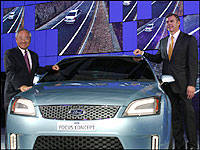 |
| Chairman and CEO of Ford Motor China, Mei-Wei Cheng and Mark Schulz, Ford Motor Company executive vice president Asia Pacific and Africa unveil the Focus Concept at Auto China 2004 in Beijing on June 8, 2004.(Photo: Ford Motor Company) |
Most intriguing will be how such new cooperative partnerships are benefiting Chinese manufacturers such as the Shanghai Automotive Industry Corp. Chinese automakers won't be able to continue building vehicles with shoddy workmanship or substandard reliability now that world class competitive models are available.
Chinese consumers now have the opportunity to preview their next car side by side with all competitors at Auto China 2004, with the China International Exhibition Center in Beijing expecting over 400,000 visitors.
Watch out world, the most highly populated country is on the verge of breaking out as an automotive powerhouse. Truly, the auto industry as we once knew it will never be the same.