





No doubt the world's global automakers will crush this spirit like a bug, unless the Chinese can be particularly innovative and use their local knowledge to develop products unique to the needs and desires of an eager Chinese public.
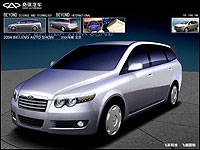 |
| Chery Automobile introduced its new MPV at Auto China 2004 in Beijing during the press days last week. The 7-seat family vehicle borrows a few design cues from Chrysler's Pacifica, but the resemblance is subtle. The well featured model will have GPS navigation and DVD entertainment as options. (Photo: Chery Automobile) |
That market grew by 34 percent since last year alone, to 4.4 million units. That puts China into second place behind only the U.S. for total sales, bypassing even mighty Germany.
Of course the Germans don't mind, at least the heads of BMW, DaimlerChrysler and Volkswagen, which have set up shop to take their portion of the proceeds. The latter manufacturer has even expressed plans to start exporting cars from China, while many others are starting to ship components such as engines and other driveline parts, being that such high-cost items are much less expensive to build in China than in the various automaker's North American, Japanese, European and even Korean counterpart plants.
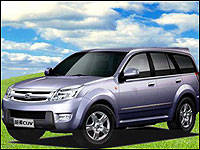 |
| Great Wall Motors, maker of low-cost SUVs and pickup trucks introduced its new Hover during Auto China 2004 press days. The Hover is based on Isuzu mechanicals. (Photo: Great Wall Motors) |
While such actions will no doubt cause rifts among auto workers and the CAW (UAW) union that represents them, the cries of foul play that will inevitably follow will without doubt fall on deaf ears.
But while North American auto workers may be displaced by shifting markets, China will keep on growing if market analysts are to be believed. Estimates of a 20 million vehicle per year market are expected by 2020, according to the Development Research Center of China's State Council. So far in 2004 sales are up 29 percent over last year's record setting results.