





Genesis of a home-made fuel-efficient car
The Avion is the product of great teamwork. Craig Henderson and his pal Bill Green co-developed the car in 1984, with the former responsible for engineering and the latter taking care of design. The Avion was originally conceived as a sports car, but real-world testing made the creators realize how little fuel it could make do with.
Now, as consumers focus heavily on fuel economy, the car that no one seemed to care about in the 1980s has suddenly become a star. In an interview for the Bellingham Herald, Henderson used the following comparison: "The Humvee is a brick and the Avion is an arrow!" A quarter of a century ago, people would have replied: "So?"
Some history lessons
Henderson and Green initially had plans for small-scale production using various components sourced from recycling companies — a green idea well ahead of its time. The original mid-mounted, gas-powered, 4-cylinder Chrysler engine used a turbocharger to generate 146 horsepower. A more modest, efficiency-oriented alternative has since replaced it, namely a 67-horsepower, 800-cc diesel engine.
The two-seat bodywork with scissor doors relies on a combination of carbon fibre, Kevlar and S-Glass fibreglass, while the tubular chassis is built from aluminum alloy. The whole thing merely weighs 703 kilos (1,550 pounds).
Sponsored by Goodyear, the latest record-breaking attempt by Henderson also involved low-friction Assurance Fuel Max tires.
Even without special rubber, the first-generation Avion could achieve an impressive 2.94 L/100 km (80 mpg) at a speed of 112.6 km/h (70 mi/h) and 2.06 L/100 km (114 mpg) at 88.5 km/h (55 mi/h). Yet, typical U.S. buyers were far more interested in performance back then; the Avion could sprint from 0 to 100 km/h in less than 5 seconds!
The Avion is the product of great teamwork. Craig Henderson and his pal Bill Green co-developed the car in 1984, with the former responsible for engineering and the latter taking care of design. The Avion was originally conceived as a sports car, but real-world testing made the creators realize how little fuel it could make do with.
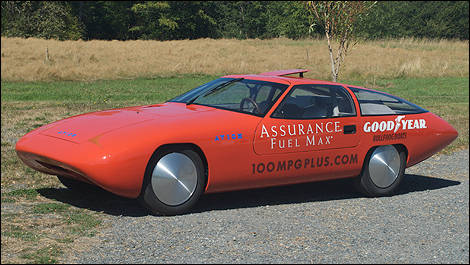 |
| On September 1st, 2010, American driver Craig Henderson set a new mileage record with the Avion at 1.975 litres per 100 kilometres. (Photo: Goodyear) |
Now, as consumers focus heavily on fuel economy, the car that no one seemed to care about in the 1980s has suddenly become a star. In an interview for the Bellingham Herald, Henderson used the following comparison: "The Humvee is a brick and the Avion is an arrow!" A quarter of a century ago, people would have replied: "So?"
Some history lessons
Henderson and Green initially had plans for small-scale production using various components sourced from recycling companies — a green idea well ahead of its time. The original mid-mounted, gas-powered, 4-cylinder Chrysler engine used a turbocharger to generate 146 horsepower. A more modest, efficiency-oriented alternative has since replaced it, namely a 67-horsepower, 800-cc diesel engine.
The two-seat bodywork with scissor doors relies on a combination of carbon fibre, Kevlar and S-Glass fibreglass, while the tubular chassis is built from aluminum alloy. The whole thing merely weighs 703 kilos (1,550 pounds).
Sponsored by Goodyear, the latest record-breaking attempt by Henderson also involved low-friction Assurance Fuel Max tires.
Even without special rubber, the first-generation Avion could achieve an impressive 2.94 L/100 km (80 mpg) at a speed of 112.6 km/h (70 mi/h) and 2.06 L/100 km (114 mpg) at 88.5 km/h (55 mi/h). Yet, typical U.S. buyers were far more interested in performance back then; the Avion could sprint from 0 to 100 km/h in less than 5 seconds!
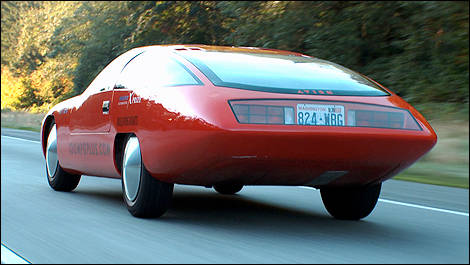 |
| (Photo: Avion Car Company) |