





Insulation of the engine compartment by panels shown in a prototype is able to significantly slow down the cooling process, with the engine remaining warm even after several hours. And each degree celsius over the surrounding temperature means a reduction in fuel consumption by approximately 0.2 per cent.
Heating with Waste Heat
To keep the warm-up period as short as possible, a solution particularly suitable on the petrol engine is to use an exhaust gas heat exchanger. Immediately after setting out, such a heat exchanger allows direct use of the waste heat coming from the drivetrain, actively warming up, say, the transmission fl uid and quickly minimising friction in the transmission.
The main savings potential offered by an exhaust gas heat exchanger in a diesel engine is the option to heat the interior. Modern diesel engines are now so efficient that the heat going into the cooling circuit and, accordingly, into the car’s heater is not always sufficient to meet the customer’s comfort requirements. An additional electric heater is therefore required, with a heating output of approximately 1,000 W. To provide this kind of energy the car consumes up to one extra litre of fuel every 100 kilometres, particularly in cold winter weather.
An exhaust gas heat exchanger would allow the driver to avoid this extra fuel consumption by using waste heat from the drivetrain to warm up the passenger compartment and thus dispensing with the additional heater. And as on the petrol engine, an exhaust gas heat exchanger would help to improve the process of the engine warming up.
Electric Power from Waste Heat – the Thermoelectric Generator
The thermoelectric generator (TEG) takes a completely different approach to the generation of energy from heat. Based on space technology, the TEG is able to convert waste heat into electric power.
After initially being presented as a separate module on the underfl oor of the car next to the catalytic converter, the thermoelectric generator now offers further options, BMW Group engineers presenting a new, integrated solution. Using synergies among various components, the new prototype TEG is fi tted in the engine compartment, to be specific in the exhaust gas recirculation cooler featured on modern diesel engines as a regular component for reducing emissions.
With exhaust gas recirculation already offering many of the features required for integrating such a generator, an elegant and sensible solution is provided here without any particular effort. When it reaches production standard, the TEG will generate 250 W, almost half the on-board consumption of a BMW 5 Series in the hands of a customer, helping to reduce fuel consumption by up to two per cent.
Used in this way, the TEG does not yet capitalise on the full potential offered by exhaust heat, since the exhaust gas recirculation system provides only some of the exhaust heat fl ow. Still, integration of such a unit in the exhaust gas recirculation system is an important step towards the subsequent more sophisticated integration of a TEG in the underfl oor of the car or in the catalytic converter, since the solution now offered provides important information on the operating principles and on obstacles which may still have to be overcome. And this know-how may then be applied in implementing an underfloor solution.
photo:BMW
Heating with Waste Heat
To keep the warm-up period as short as possible, a solution particularly suitable on the petrol engine is to use an exhaust gas heat exchanger. Immediately after setting out, such a heat exchanger allows direct use of the waste heat coming from the drivetrain, actively warming up, say, the transmission fl uid and quickly minimising friction in the transmission.
The main savings potential offered by an exhaust gas heat exchanger in a diesel engine is the option to heat the interior. Modern diesel engines are now so efficient that the heat going into the cooling circuit and, accordingly, into the car’s heater is not always sufficient to meet the customer’s comfort requirements. An additional electric heater is therefore required, with a heating output of approximately 1,000 W. To provide this kind of energy the car consumes up to one extra litre of fuel every 100 kilometres, particularly in cold winter weather.
An exhaust gas heat exchanger would allow the driver to avoid this extra fuel consumption by using waste heat from the drivetrain to warm up the passenger compartment and thus dispensing with the additional heater. And as on the petrol engine, an exhaust gas heat exchanger would help to improve the process of the engine warming up.
Electric Power from Waste Heat – the Thermoelectric Generator
The thermoelectric generator (TEG) takes a completely different approach to the generation of energy from heat. Based on space technology, the TEG is able to convert waste heat into electric power.
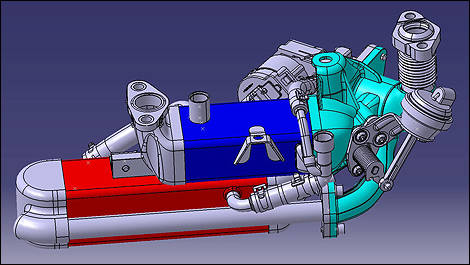 |
| Thermoelectric Generator (TEG) integrated in the exhaust gas recirculation. |
After initially being presented as a separate module on the underfl oor of the car next to the catalytic converter, the thermoelectric generator now offers further options, BMW Group engineers presenting a new, integrated solution. Using synergies among various components, the new prototype TEG is fi tted in the engine compartment, to be specific in the exhaust gas recirculation cooler featured on modern diesel engines as a regular component for reducing emissions.
With exhaust gas recirculation already offering many of the features required for integrating such a generator, an elegant and sensible solution is provided here without any particular effort. When it reaches production standard, the TEG will generate 250 W, almost half the on-board consumption of a BMW 5 Series in the hands of a customer, helping to reduce fuel consumption by up to two per cent.
Used in this way, the TEG does not yet capitalise on the full potential offered by exhaust heat, since the exhaust gas recirculation system provides only some of the exhaust heat fl ow. Still, integration of such a unit in the exhaust gas recirculation system is an important step towards the subsequent more sophisticated integration of a TEG in the underfl oor of the car or in the catalytic converter, since the solution now offered provides important information on the operating principles and on obstacles which may still have to be overcome. And this know-how may then be applied in implementing an underfloor solution.
photo:BMW