




Three joint projects – one common goal
The Ko-FAS initiative comprises three joint projects, known as Ko-TAG, Ko-PER and Ko-KOMP. The research and technology department of the BMW Group is heading the Ko-TAG and Ko-PER projects.
The specialists involved in the Ko-TAG project will be conducting research in the field of Car2Tag communication, which employs a network of transponders whose function it is to precisely locate and classify objects using cooperative sensory systems. The aim in future is to employ this technology to protect particularly vulnerable road users, such as pedestrians and cyclists but it is also to be used in the area of vehicle-vehicle safety.
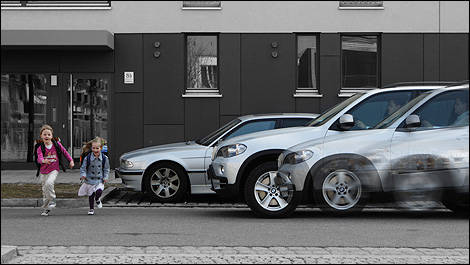
Employees of BMW Group Research and Technology successfully developed the first pedestrian protection system to be based on this kind of technology during the AMULETT project, which preceded the current one. It involved a test vehicle which exchanged wireless data with an active module, similar to RFID, which can be integrated into a child's schoolbag, for example. This cooperative sensor technology would make it possible to locate such individuals and classify them as vulnerable road users who are not visible to the driver at the moment in which the risk situation occurs.
Ko-TAG will take the findings of the AMULETT project as its starting point and subject them to further studies. Researchers are now particularly interested in such questions as how this radio technology can be employed in more intense situations, such as those in which many people are involved. "In future, this radio technology will allow us to draw extremely precise and highly reliable assumptions from the sensory data. This will in turn provide us with a means of effecting yet another considerable improvement in road safety," explains Daniel Schwarz of BMW Group Research and Technology, and project spokesman for Ko-TAG.
The Ko-PER project is responsible for conducting research into processes of cooperative perception in longitudinal traffic and at intersection areas. "For this project, we are supported by the findings of the successfully concluded EU research 'PReVENT' project, but what we are now also looking for is an active exchange with the national 'simTD' (Safe Intelligent Mobility Test Field for Germany) support project. The various research activities all lead towards the same joint goal – to increase the level of safety on the roads," says Dr. Reiner Wertheimer, Ko-PER project spokesman for BMW Group Research and Technology. The researchers from the BMW Group involved in the Ko-PER project are looking into ways of utilising cooperative sensory networks for mapping out the traffic environment. The aim is to create an overall picture of the immediate traffic environment by exchanging and merging information from various sensors, employed to gather data in both vehicle environments and transport infrastructures. What researchers are aiming at in particular is to create a way of revealing hidden road users and identifying the dynamic chronology of road events. This will make it possible to conduct a constant and comprehensive assessment of existing collision risks.
The members of the Ko-KOMP project will be researching into protection systems for vehicles which are activated prior to an impending collision and whose aim it is to prevent an accident from occurring or at least tempering the consequences of the accident. In particular, the project will be involved in examining systems for expanding the external vehicle shell and effecting the timely activation of autonomous emergency-brake functions. Also planned is a virtual test field for simulating communications channels for diverse road traffic scenarios.
BMW Research and Technology (BMW Forschung und Technik GmbH) is a wholly-owned subsidiary of the BMW Group and has, since 2003, been responsible for researching into such fields as VehicleTechnology, CleanEnergy (hydrogen technology), EfficientDynamics (intelligent energy management/alternative drive systems), ConnectedDrive (driver assistance/active safety) and ITDrive (IT architecture and communications technology). The legal independence of the limited company (GmbH) guarantees the operation's creative freedom and maximises its flexibility. Its access to worldwide trends and technologies is ensured by an international network of bases, at Palo Alto and Clemson (USA) and Tokyo (Japan), as well as l iaison offices with Eurécom (Sophia Antipolis, France) and the German Research Centre for Artificial Intelligence (DFKI GmbH, Saarbrücken).
photo:BMW
The Ko-FAS initiative comprises three joint projects, known as Ko-TAG, Ko-PER and Ko-KOMP. The research and technology department of the BMW Group is heading the Ko-TAG and Ko-PER projects.
The specialists involved in the Ko-TAG project will be conducting research in the field of Car2Tag communication, which employs a network of transponders whose function it is to precisely locate and classify objects using cooperative sensory systems. The aim in future is to employ this technology to protect particularly vulnerable road users, such as pedestrians and cyclists but it is also to be used in the area of vehicle-vehicle safety.
Employees of BMW Group Research and Technology successfully developed the first pedestrian protection system to be based on this kind of technology during the AMULETT project, which preceded the current one. It involved a test vehicle which exchanged wireless data with an active module, similar to RFID, which can be integrated into a child's schoolbag, for example. This cooperative sensor technology would make it possible to locate such individuals and classify them as vulnerable road users who are not visible to the driver at the moment in which the risk situation occurs.
Ko-TAG will take the findings of the AMULETT project as its starting point and subject them to further studies. Researchers are now particularly interested in such questions as how this radio technology can be employed in more intense situations, such as those in which many people are involved. "In future, this radio technology will allow us to draw extremely precise and highly reliable assumptions from the sensory data. This will in turn provide us with a means of effecting yet another considerable improvement in road safety," explains Daniel Schwarz of BMW Group Research and Technology, and project spokesman for Ko-TAG.
 |
The Ko-PER project is responsible for conducting research into processes of cooperative perception in longitudinal traffic and at intersection areas. "For this project, we are supported by the findings of the successfully concluded EU research 'PReVENT' project, but what we are now also looking for is an active exchange with the national 'simTD' (Safe Intelligent Mobility Test Field for Germany) support project. The various research activities all lead towards the same joint goal – to increase the level of safety on the roads," says Dr. Reiner Wertheimer, Ko-PER project spokesman for BMW Group Research and Technology. The researchers from the BMW Group involved in the Ko-PER project are looking into ways of utilising cooperative sensory networks for mapping out the traffic environment. The aim is to create an overall picture of the immediate traffic environment by exchanging and merging information from various sensors, employed to gather data in both vehicle environments and transport infrastructures. What researchers are aiming at in particular is to create a way of revealing hidden road users and identifying the dynamic chronology of road events. This will make it possible to conduct a constant and comprehensive assessment of existing collision risks.
The members of the Ko-KOMP project will be researching into protection systems for vehicles which are activated prior to an impending collision and whose aim it is to prevent an accident from occurring or at least tempering the consequences of the accident. In particular, the project will be involved in examining systems for expanding the external vehicle shell and effecting the timely activation of autonomous emergency-brake functions. Also planned is a virtual test field for simulating communications channels for diverse road traffic scenarios.
BMW Research and Technology (BMW Forschung und Technik GmbH) is a wholly-owned subsidiary of the BMW Group and has, since 2003, been responsible for researching into such fields as VehicleTechnology, CleanEnergy (hydrogen technology), EfficientDynamics (intelligent energy management/alternative drive systems), ConnectedDrive (driver assistance/active safety) and ITDrive (IT architecture and communications technology). The legal independence of the limited company (GmbH) guarantees the operation's creative freedom and maximises its flexibility. Its access to worldwide trends and technologies is ensured by an international network of bases, at Palo Alto and Clemson (USA) and Tokyo (Japan), as well as l iaison offices with Eurécom (Sophia Antipolis, France) and the German Research Centre for Artificial Intelligence (DFKI GmbH, Saarbrücken).
photo:BMW