


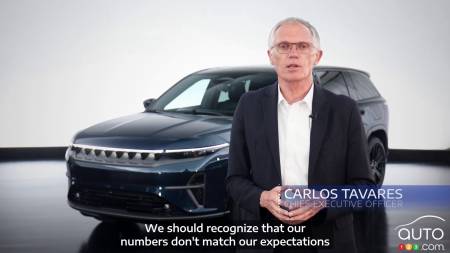



Just under a year after stepping down as CEO of Stellantis, Carlos Tavares is sounding the alarm: the auto giant could one day split up into parts if internal tensions between its main zones of influence — France, Italy and the United States — are not better managed.
In his new book published late last week in France, Tavares writes that he fears the rupture of the tripartite balance that binds the three entities. According to him, the group's survival “will depend on constant attention to its unity” to prevent it from being “pulled in several directions at once”.
A giant born from a complex merger
Created in 2021 from the merger between Fiat Chrysler Automobiles (FCA) and the PSA group (Peugeot-Citroën), Stellantis has a diverse collection of 14 brands under its umbrella—from Jeep and Ram to Peugeot, Opel, Alfa Romeo and Maserati.
But the complexity of this portfolio is becoming a burden as automotive demand stagnates in Europe, Chinese competition intensifies and geopolitical tensions complicate the massive technological investments required for electrification.
A turbulent exit for Tavares
Now 67 years of age, Tavares left his post last December after the company experienced sharp drops in market share in Europe and the U.S., accompanied by a significant decline in profits.
His tenure had been marked by an aggressive cost-cutting policy, relocations to low-cost countries like Morocco and frontal opposition to unions and the Italian government.
His approach, deemed too focused on savings, also reportedly led to quality and product positioning problems, according to analysts.
A disputed legacy
In his book, Tavares disputes the official version of the circumstances of his departure and affirms having always sought to defend French interests within the group. Stellantis, for its part, is declining to comment on its former executive's remarks.
Antonio Filosa in to stabilize the group
New CEO Antonio Filosa, who took office in June 2025 after a long search, is trying to restore stability. He has already abandoned certain European investments, promised to invest $13 billion USD stateside in the group's most profitable market and appointed several executives from the former Fiat Chrysler, often linked to Latin America.
These choices are reviving concerns among European unions, particularly in France and Italy, as several factories are currently operating below capacity.
Towards a Europe–America separation?
Tavares goes further: he envisions a possible split of activities between Europe and North America. “A possible scenario would be that a Chinese manufacturer might one day make an offer for the European activities, while the Americans take over the North American ones,” he writes. "This would allow each to refocus on its market, similar to what General Motors has been doing for 10 years."
Beyond personal grudges, Tavares's message seems aimed at preventing an internal fragmentation of a group born from delicate cultural and political compromises.
With the rise of global competition and pressure from governments to preserve local employment, Stellantis risks becoming the symbol of the challenges of a changing automotive globalization.