





Car-based commercial vehicles, including sedan deliveries, remained in production, but the heavy-duty chassis of the Suburban increasingly found favor with professional customers. In the post-World War II years, its popularity with private customers who appreciated its uncompromising capabilities increased steadily.
The Chevrolet Suburban hit the mainstream in the early 1990s, with the overall popularity of sport-utility vehicles. But while many customers were new to the Suburban then, it had garnered a legion of longtime owners who had purchased multiple examples over the years – using them to haul Little League teams and their equipment, tow a horse trailer or seat a work crew on the way to a job site.
Here’s a timeline of significant moments in the Suburban’s first 75 years:
1935: Suburban Carryall introduced with a signature two-door body style that would last through 1967. Power came from Chevrolet’s stalwart “Stovebolt” inline-six that produced 60 horsepower (45 kW) for the half-ton chassis.
1937: New, streamlined exterior styling carried Art Deco cues, and horsepower from the Stovebolt six increased to 79 (59 kW).
1942: Production of almost all civilian cars and trucks halted during America’s involvement in World War II, although many Chevy trucks – including the Suburban’s body style – were pressed into military duty.
1947: The first significant redesign of the Chevrolet’s truck line – including Suburban – since before the war. Torque from the inline-six engine was 174 lb.-ft. (217 Nm) at only 1,200 rpm, giving the Suburban excellent towing capability.
1950: Suburban models are offered with either a tailgate/top-opening rear window configuration or conventional “barn doors” at the rear.
1955: Revolutionary new styling is introduced midway through the model year. Known as the “second series” design, it features a wraparound windshield and the elimination of running boards – the body is flush with the fenders for the first time. The second series model also introduces the ubiquitous small-block V-8.
1957: Factory-installed four-wheel drive is offered for the first time, with the famous NAPCO-supplied “Powr-Pak” system.
1960: Chevrolet institutes the C/K designations to denote models with 2WD (C) and 4WD (K). Front-end styling is also new.
 |
| 1960 Chevrolet Suburban |
The Chevrolet Suburban hit the mainstream in the early 1990s, with the overall popularity of sport-utility vehicles. But while many customers were new to the Suburban then, it had garnered a legion of longtime owners who had purchased multiple examples over the years – using them to haul Little League teams and their equipment, tow a horse trailer or seat a work crew on the way to a job site.
Here’s a timeline of significant moments in the Suburban’s first 75 years:
1935: Suburban Carryall introduced with a signature two-door body style that would last through 1967. Power came from Chevrolet’s stalwart “Stovebolt” inline-six that produced 60 horsepower (45 kW) for the half-ton chassis.
1937: New, streamlined exterior styling carried Art Deco cues, and horsepower from the Stovebolt six increased to 79 (59 kW).
1942: Production of almost all civilian cars and trucks halted during America’s involvement in World War II, although many Chevy trucks – including the Suburban’s body style – were pressed into military duty.
1947: The first significant redesign of the Chevrolet’s truck line – including Suburban – since before the war. Torque from the inline-six engine was 174 lb.-ft. (217 Nm) at only 1,200 rpm, giving the Suburban excellent towing capability.
1950: Suburban models are offered with either a tailgate/top-opening rear window configuration or conventional “barn doors” at the rear.
1955: Revolutionary new styling is introduced midway through the model year. Known as the “second series” design, it features a wraparound windshield and the elimination of running boards – the body is flush with the fenders for the first time. The second series model also introduces the ubiquitous small-block V-8.
1957: Factory-installed four-wheel drive is offered for the first time, with the famous NAPCO-supplied “Powr-Pak” system.
1960: Chevrolet institutes the C/K designations to denote models with 2WD (C) and 4WD (K). Front-end styling is also new.
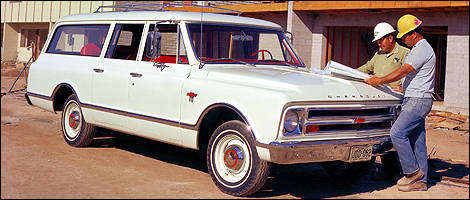 |
| 1967 Chevrolet Suburban |