





 |
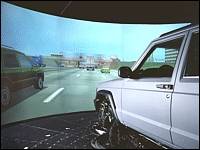
| This Jeep Cherokee sits inside a 64-foot-by-64-foot simulator to help reproduce lifelike driving situations. (Photo: NHTSA - www-nrd.nhtsa.dot.gov) |
NADS is a 64-foot-by-64-foot simulator where the driver sits in a special test vehicle like a Ford Taurus, minus the engine, that is mounted inside a domed platform. Cameras mounted inside the dome offer the driver a view of a simulated road.
The key to the nearly $12 million NADS project is that its simulator can travel around the nearly 4,100 square foot room, making 330 degree turns. This allows the driver to experience the effects of acceleration, braking and steering as if they were driving a real car or truck.
Some auto manufacturers, such as Ford Motor Company, use much more static simulators that sway on huge piston-like legs or are completely stationary.
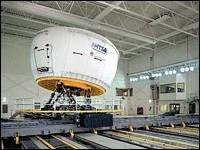 |
| An exterior view of the 64-foot-by-64-foot NADS simulator. (Photo: NHTSA) |
NADS allows the federal government and its industry partners to explore different driving conditions and see how novice to experienced drivers can handle sensory overload without endangering them in the real world environment, Hench said. The simulator will be used to gather information to establish future government safety standards.
Like Siemens VDO, Delphi is also concerned with safely integrating the bewildering number of automotive electronics systems into the vehicle cockpit, said Rohr.
Delphi is looking at the complete driving experience to first increase drivers' abilities to control the vehicle and avoid accidents, and second to offer occupant protection when something goes wrong.
Increasingly, the auto industry's attention is focused on providing systems that will help drivers avoid crashes all together, Rohr said. "Studies have shown that if we can give drivers an additional second to react, we can significantly reduce accidents."