





 |
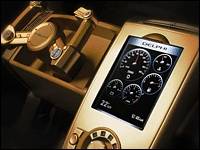
| Delphi is constantly working on new innovative ways of man/machine communication. (Photo: Delphi) |
Increasingly, the auto industry's attention is focused on providing systems that will help drivers avoid crashes all together, Rohr said. "Studies have shown that if we can give drivers an additional second to react, we can significantly reduce accidents."
For example, it is estimated that with an additional second of warning time, 90 percent of rear end vehicle collisions could be reduced, along with 90 percent of crashes at intersections, including 77 percent of rear collisions that involve a moving car approaching a stationary vehicle. To provide this additional warning time, the auto companies are beginning to deploy a number of radar, laser and visual systems, but now the question is how to provide warnings in a non-distracting and beneficial way, Rohr said.
If an external sensor detects a potential rear-end collision, the warning buzzer or light shouldn't go off in the front of the vehicle, distracting the driver's attention away from the source of danger, he noted.
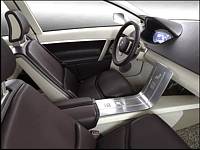 |
| The Volvo VCC concept's floating center stack is becoming a very popular design element in today's prototypes. (Photo: Volvo) |
And, when it comes to that point of no return, where an accident is unavoidable, the industry is looking at linking the external sensory systems to "smart" restraints inside the vehicle, Rohr said. Air bags could be prepared to fire and seat belts automatically retract to bring passengers into a better position in their seats moments before a potential impact, offering improved protection. Using internal sensors, noting the passenger's size, weight, and seating positions, protection could then be tailored to fit each person--not firing an air bag, for instance, if the occupant is an infant in a rear facing seat.
But then, the challenge is to make such an integrated system in a way where it doesn't sound too many false alarms, and is automatically "resettable" if a collision does not, in fact, occur, Rohr said.
The trend for the future is that consumers will continue to demand safety improvements inside the car while regulators will drive some of the changes, Rohr said. "Our focus will be shifting from not just saving lives, but to minimize injuries and then to avoid accidents altogether."