"Anything and everything drivers could do, they did during the study," commented Jacqueline Glassman, the acting administrator
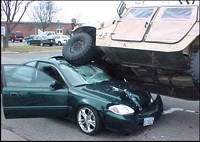 |
| Driver inattention is the leading cause of accidents. (Photo: About.com) |
of the National Highway Traffic Safety Administration. "This is a wake-up call to America to pay attention while driving."
Amazingly, although all drivers were aware of being monitored by camera, some even drank beer while driving, one toked on a marijuana joint and a number of others repeatedly engaged in road rage incidents and regularly violated traffic laws. One young woman (19) hit a tree head-on while traveling at 30 km/h (20 mph). Complicating matters she wasn't wearing a seatbelt and therefore hit the windshield, after which she drove home without calling police, as is required by law.
According to a report, another 19-year-old woman became lost in a residential
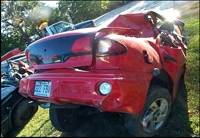 |
| Some cars are more capable of protecting occupants than others. (Photo: About.com) |
neighborhood and then while taking out her phone to call for directions a child rode into the street on a tricycle. She only managed to stop within 6 meters (20 feet) of hitting the child. In another incident, a different driver, who appeared inebriated, crossed over the centre line and came close to running head-on into an oncoming vehicle, which careened over to the shoulder to avoid collision. Clearly there's a problem.
And while accidents involving firearms or medical and/or surgical complications, per se, get a lot of press due to political pressures, their impact on society on the whole is minimal in comparison. For instance, in a 2002 study on U.S. death rates and causes only 0.8
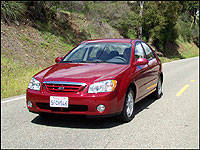 |
| Even less expensive cars are much safer today, thanks to the inclusionof multiple airbags and other safety related features. (Photo: TrevorHofmann, Canadian Auto Press) |
percent of accidental deaths were caused by firearms and 3.1 percent by medical or surgical complication. In comparison motor vehicle accidents (MVA) were responsible for 44.3 percent.
But is it getting worse or safer for motorists and their passengers? Actually, the chances of dying in a vehicle in 1953 were four times greater than in 2003, based on fatalities per mile driven in the United States. Improved roads, better medical care and stronger DUI laws are cited as differentiators, although improvements in the construction of vehicles, including the addition of passive and active safety features, especially a modern day vehicle's ability to avoid an accident in the first place thanks to improved suspension
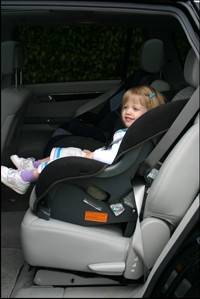 |
| Road fatalities are lower than ever, but 43,200 U.S. deaths in 2005, and a similar per capita number in Canada, are still too many, especially if one of them was a member of your family. (Photo: TrevorHofmann, Canadian Auto Press) |
components, probably make up the majority of difference. Other benefits most modern vehicles enjoy include power disc brakes, four-wheel antilock brake systems, radial-ply tires, penetration-resistant windshields, padded dashboards, collapsible steering columns, structural reinforced passenger compartments supported by integrated crumple zones, three-point safety belts, multiple airbags, and even sun visors are noted as making a difference. As already mentioned, newer technologies including radar, camera equipment and sensors could improve accident avoidance even further.
Road fatalities in the U.S. dropped from 52,627 in 1970 to 43,200 last year, while in approximately the same period road fatalities in Germany were reduced from 21,000 to 6,949 per year. The study says that a significant part of the difference is attributed to Electronic Stability Control (ECS), which is found in half of German cars, but only 6 percent of those in the United States at the time of the study, three years ago. ESC has increased within the SUV segment recently, and a reduction in the number of accidents due to loss of control should follow in North American markets as well. Just the same, it could get a lot better.