





Oxford Brookes University’s Sustainable Vehicle Engineering Centre will manage the collation of qualitative and quantitative research throughout the UK trial. This will include analysis of driver experiences with the MINI E, as well as reviewing the technical information provided by the data-logging units fitted to every MINI E.
The consortium is strengthened by public sector organisations from the South East England Development Agency (SEEDA), Oxford City Council and Oxfordshire County Council. Pam Alexander, SEEDA Chief Executive, said: “SEEDA is delighted to be contributing £825,000 to this exciting collaboration. We aim to drive growth in the South East through innovation which creates prosperity and high value jobs. A core aspect of our focus is to develop green technology and a sustainable transport infrastructure to win global market share in the technologies that will deliver a low carbon future.”
SEEDA, Southern and Scottish Energy, Oxford City Council and Oxfordshire County Council are trialling 20 of the MINI E trial cars in a fleet environment. This requires the establishment of an appropriate technical infrastructure in each organisation’s local area and contributes further to the consortium’s common objective of being at the forefront of sustainable transport initiatives.
MINI E specification and performance
The MINI E’s electric drive train produces a peak torque of 220 Nm and a power output equivalent to 204hp. Drive is delivered to the front wheels via a single-stage helical gearbox. This unique engine and transmission arrangement powers the MINI E seamlessly to 62 mph in 8.5 seconds and on to an electronically-limited top speed of 95 mph.
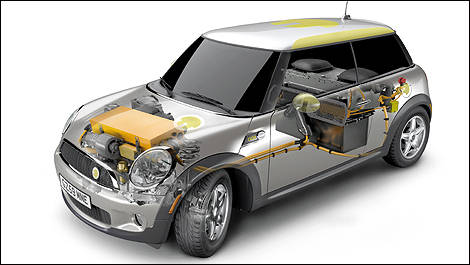
Based on the familiar MINI Hatch, MINI E is a two-seater because the space normally used by rear passengers is reserved for a lithium-ion battery. This state-of-the-art rechargeable battery unit combines high output with ample storage capacity and a remarkable power output. It has a maximum capacity of 35 kilowatt hours (kWh) and transmits energy to the electric motor as a direct current at a nominal 380 volts. It comprises 5,088 cells grouped into 48 modules, which are packaged into three battery elements arranged compactly inside the MINI E.
Driven by electricity: zero emissions at point of use, at minimal cost
A full recharge draws a maximum of 28 kilowatt hours of electricity from the grid. Each kilowatt hour translates into 5.4 miles giving the MINI E a theoretical range of over 150 miles. Besides the benefit of zero-emissions driving, at point of use, the MINI E offers significant economic advantages over a vehicle powered by a conventional internal combustion engine.
As soon as the driver lifts his or her foot off the accelerator pedal, the electric motor acts as a generator. This results in braking force and the power recovered from the kinetic energy is fed back to the battery. In city traffic, some 75 per cent of all deceleration can be done without the brakes. Making substantial use of this energy regeneration feature extends the car’s range by up to 20 per cent and contributes to a smooth driving experience.
The first fun-to-drive small electric car
The MINI E proves that more sustainable cars do not have to be dull. BMW Group is committed to producing products that are fun to drive, and this is also an essential part of MINI’s DNA. The MINI E demonstrates all the traditional MINI characteristics – go kart-like handling, whizzy acceleration, positive feedback through the steering wheel and a cosseting cockpit. It may be electrically-powered but MINI E remains a grin-a-minute.
photo:MINI
The consortium is strengthened by public sector organisations from the South East England Development Agency (SEEDA), Oxford City Council and Oxfordshire County Council. Pam Alexander, SEEDA Chief Executive, said: “SEEDA is delighted to be contributing £825,000 to this exciting collaboration. We aim to drive growth in the South East through innovation which creates prosperity and high value jobs. A core aspect of our focus is to develop green technology and a sustainable transport infrastructure to win global market share in the technologies that will deliver a low carbon future.”
SEEDA, Southern and Scottish Energy, Oxford City Council and Oxfordshire County Council are trialling 20 of the MINI E trial cars in a fleet environment. This requires the establishment of an appropriate technical infrastructure in each organisation’s local area and contributes further to the consortium’s common objective of being at the forefront of sustainable transport initiatives.
 |
MINI E specification and performance
The MINI E’s electric drive train produces a peak torque of 220 Nm and a power output equivalent to 204hp. Drive is delivered to the front wheels via a single-stage helical gearbox. This unique engine and transmission arrangement powers the MINI E seamlessly to 62 mph in 8.5 seconds and on to an electronically-limited top speed of 95 mph.
Based on the familiar MINI Hatch, MINI E is a two-seater because the space normally used by rear passengers is reserved for a lithium-ion battery. This state-of-the-art rechargeable battery unit combines high output with ample storage capacity and a remarkable power output. It has a maximum capacity of 35 kilowatt hours (kWh) and transmits energy to the electric motor as a direct current at a nominal 380 volts. It comprises 5,088 cells grouped into 48 modules, which are packaged into three battery elements arranged compactly inside the MINI E.
Driven by electricity: zero emissions at point of use, at minimal cost
A full recharge draws a maximum of 28 kilowatt hours of electricity from the grid. Each kilowatt hour translates into 5.4 miles giving the MINI E a theoretical range of over 150 miles. Besides the benefit of zero-emissions driving, at point of use, the MINI E offers significant economic advantages over a vehicle powered by a conventional internal combustion engine.
As soon as the driver lifts his or her foot off the accelerator pedal, the electric motor acts as a generator. This results in braking force and the power recovered from the kinetic energy is fed back to the battery. In city traffic, some 75 per cent of all deceleration can be done without the brakes. Making substantial use of this energy regeneration feature extends the car’s range by up to 20 per cent and contributes to a smooth driving experience.
The first fun-to-drive small electric car
The MINI E proves that more sustainable cars do not have to be dull. BMW Group is committed to producing products that are fun to drive, and this is also an essential part of MINI’s DNA. The MINI E demonstrates all the traditional MINI characteristics – go kart-like handling, whizzy acceleration, positive feedback through the steering wheel and a cosseting cockpit. It may be electrically-powered but MINI E remains a grin-a-minute.
photo:MINI