


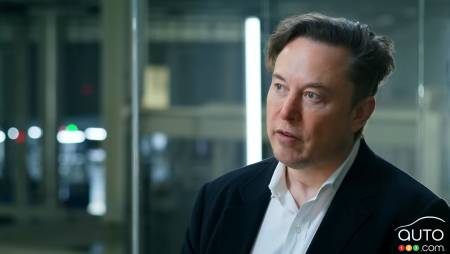



Elon Musk's new compensation plan at Tesla could earn him over $50 billion USD, even without the most ambitious performance objectives being met.
Recall that Tesla's board of directors approved a historic compensation plan for its founder and chief executive in September, valued at $878 billion in stock over 10 years.
'Nothing,' but not really
Officially, Elon Musk would get “nothing” without achieving what are deemed “incredibly ambitious” goals: revolutionizing Tesla, robotics, autonomous driving and society itself.
But according to an analysis by Reuters and several experts, Elon Musk could pocket more than $50 billion by hitting only a few modest targets, a far cry from those ambitious goals.
Vague objectives for billions of dollars
Some targets in the compensation plan are based on poorly defined concepts. For example, Tesla requires 10 million subscriptions to its Full Self-Driving (FSD) software, without it needing to become truly autonomous. Experts note that Tesla could easily reach this figure by simply lowering the subscription price, which is currently $8,000 USD or $99 USD per month.
Similarly, the goal of one million robotaxis in service does not specify that the vehicles must operate without human supervision; that would allow Tesla to meet the target with its current tests being conducted in Austin, Texas.
Finally, the target of one million Optimus robots—supposedly humanoid—remains intentionally vague, defining a “bot” as any product with mobility and artificial intelligence.
Colossal gains for limited performance
The analysis shows that achieving just two objectives, combined with a market capitalization of $2.5 trillion, would be enough to net Elon Musk $26.4 billion in stock. Three objectives and a $3 trillion valuation would bring that figure to $54.6 billion, without Tesla having to produce a single fully autonomous car.
For comparison, this sum exceeds the combined compensation of the eight highest-paid CEOs in the world, including Mark Zuckerberg (Meta), Tim Cook (Apple) and Jensen Huang (Nvidia).
Market cap growth is easier to achieve than profits
The profit targets are significantly harder to hit. The plan includes eight profit tiers, from $50 billion to $400 billion in pre-tax profits, whereas Tesla only made $16.6 billion in 2024.
However, the market capitalization goals could prove to be much simpler: a growth rate of 6.4 percent per year would be enough for Tesla to reach a value of $2 trillion by 2035, a pace slower than the historical average of the S&P 500 index.
According to Seth Goldstein, an analyst at Morningstar, “Tesla could reach $3 trillion without exceptional performance, as its value is already based on future products that do not yet exist.”
A risky bet for Tesla
Tesla's board of directors considers that only Elon Musk is capable of transforming the company into an artificial intelligence giant. But several corporate governance experts argue that entrusting so much power to a single individual represents a major risk.
"Tesla has given Elon Musk a monopoly on the CEO position," says Wei Jiang, vice dean of Emory University's business school. Good governance, she says, requires a competitive market, including for executives.