





Q: Earlier this year, much was made of requests for engine modifications that had been made by other engine suppliers. Can you explain the process by which this is done?
White: The rules concerning changes to the specification of the homologated engine are remarkably simple. No changes to the homologated engine are permitted for any reason except with the prior approval of the FIA; hence the engine 'freeze' we commonly talk about.
This doesn't mean that the specification of the engines is completely static. These are very sophisticated engines operated at the limit of their performance and reliability envelope. The installation of the engine and its use evolve from year to year and the duty cycle becomes more severe as engine life increases and car performance improves. Each engine supplier may have legitimate reasons to request approval for such modifications, such as fixing reliability or quality problems or to manage changes in the supply chain. The requests take the form of an explanation of the reason for the proposed change, plus a description of the modification (including full drawings of any modified parts) and an assessment of the effects of the change.
Based on our experience, the FIA deals thoroughly with each request and, prior to approving any changes and in accordance with the Sporting Regulations, the FIA consults the other engine suppliers. It is a system that works well to manage changes that remain modest in scope and quantity relative to the complexity of these engines.
Q:Under homologated engine regulations, where are the challenges for the engine suppliers?
White: At Renault, our objective is to supply and operate engines capable of winning races and championships. This is a formidable challenge, independent of the restrictions on engine development, and the engine homologation regulations represent an additional constraint. To do so, we work closely with our chassis colleagues to maximise the performance of the Renault-powered cars.
The installation of the engine in the chassis and the operating conditions of the engine in the car aim to maximise the overall car performance.
We aim for zero-defect reliability, but not at any cost: our challenge is to manage the performance and reliability of the engine together. Any failure or shortcoming in reliability has an immediate impact on our performance, so we try to rigorously prepare to avoid incidents and we aim to react swiftly if ever an incident reaches the track in spite of this preparation.
Finally, we aim to extract maximum performance from the engines at the track. Again, it relies upon factory-based performance work to enable our track engineers to have the information needed to operate the engines to their full potential.
Q:This season's race calendar expanded to 19 races but the allocation of eight engines per drivers remained the same. How have you managed this additional constraint?
White: By simple arithmetic it is can be seen that that on average the engines must do 12% more km (19 races instead of 17 in 2009) and that at least three engines must do three races, rather than at least one engine in 2009. Along with the other important changes from 2009 to 2010 (no refuelling, increased performance of 2010 cars), this is taken into account in the design of our validation procedures. Our test cycle on the dyno, and our engine use in track testing before the season and on Fridays of race weekends, are designed to validate our engine to the increased life in the more severe conditions of 2010.
Q:Renault has supplied engines to Red Bull since 2007 and other teams have been mentioned for 2011. What is the status of negotiations?
White: We have an excellent relationship with Red Bull and we hope to continue to build on it for the future. We have the capacity to supply additional teams in the future and would be willing to do so if it was good for Renault and for the sport as a whole. We would maintain our policy to supply strictly the same performance specification to all Renault powered cars. There has been speculation in the press, with different teams mentioned from time to time, but no announcement is imminent.
Q:There is major change for the powertrain on the horizon in 2013. What can you tell us about the possible configuration of that engine?
White: Renault supports a Formula One which is sustainable in terms of eco-responsibility, improved show, road relevance and controlled costs. We are pleased to participate in discussions led by the FIA to make recommendations concerning the new powertrain rules for Formula One. Within Renault, we have taken guidance from our mainstream colleagues and feel a downsized gasoline direct injection (GDI) turbocharged engine with advanced energy recovery systems and additional electric traction would make sense to satisfy these objectives. From the discussions so far, it seems that such a configuration could be acceptable to all the stakeholders in the sport.
White: The rules concerning changes to the specification of the homologated engine are remarkably simple. No changes to the homologated engine are permitted for any reason except with the prior approval of the FIA; hence the engine 'freeze' we commonly talk about.
This doesn't mean that the specification of the engines is completely static. These are very sophisticated engines operated at the limit of their performance and reliability envelope. The installation of the engine and its use evolve from year to year and the duty cycle becomes more severe as engine life increases and car performance improves. Each engine supplier may have legitimate reasons to request approval for such modifications, such as fixing reliability or quality problems or to manage changes in the supply chain. The requests take the form of an explanation of the reason for the proposed change, plus a description of the modification (including full drawings of any modified parts) and an assessment of the effects of the change.
Based on our experience, the FIA deals thoroughly with each request and, prior to approving any changes and in accordance with the Sporting Regulations, the FIA consults the other engine suppliers. It is a system that works well to manage changes that remain modest in scope and quantity relative to the complexity of these engines.
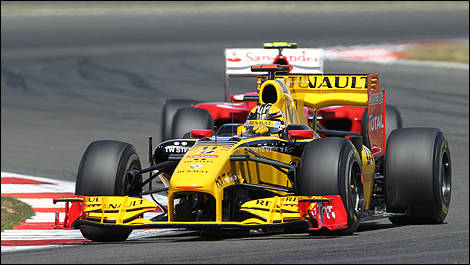 |
| Photo: Renault |
Q:Under homologated engine regulations, where are the challenges for the engine suppliers?
White: At Renault, our objective is to supply and operate engines capable of winning races and championships. This is a formidable challenge, independent of the restrictions on engine development, and the engine homologation regulations represent an additional constraint. To do so, we work closely with our chassis colleagues to maximise the performance of the Renault-powered cars.
The installation of the engine in the chassis and the operating conditions of the engine in the car aim to maximise the overall car performance.
We aim for zero-defect reliability, but not at any cost: our challenge is to manage the performance and reliability of the engine together. Any failure or shortcoming in reliability has an immediate impact on our performance, so we try to rigorously prepare to avoid incidents and we aim to react swiftly if ever an incident reaches the track in spite of this preparation.
Finally, we aim to extract maximum performance from the engines at the track. Again, it relies upon factory-based performance work to enable our track engineers to have the information needed to operate the engines to their full potential.
Q:This season's race calendar expanded to 19 races but the allocation of eight engines per drivers remained the same. How have you managed this additional constraint?
White: By simple arithmetic it is can be seen that that on average the engines must do 12% more km (19 races instead of 17 in 2009) and that at least three engines must do three races, rather than at least one engine in 2009. Along with the other important changes from 2009 to 2010 (no refuelling, increased performance of 2010 cars), this is taken into account in the design of our validation procedures. Our test cycle on the dyno, and our engine use in track testing before the season and on Fridays of race weekends, are designed to validate our engine to the increased life in the more severe conditions of 2010.
Q:Renault has supplied engines to Red Bull since 2007 and other teams have been mentioned for 2011. What is the status of negotiations?
White: We have an excellent relationship with Red Bull and we hope to continue to build on it for the future. We have the capacity to supply additional teams in the future and would be willing to do so if it was good for Renault and for the sport as a whole. We would maintain our policy to supply strictly the same performance specification to all Renault powered cars. There has been speculation in the press, with different teams mentioned from time to time, but no announcement is imminent.
Q:There is major change for the powertrain on the horizon in 2013. What can you tell us about the possible configuration of that engine?
White: Renault supports a Formula One which is sustainable in terms of eco-responsibility, improved show, road relevance and controlled costs. We are pleased to participate in discussions led by the FIA to make recommendations concerning the new powertrain rules for Formula One. Within Renault, we have taken guidance from our mainstream colleagues and feel a downsized gasoline direct injection (GDI) turbocharged engine with advanced energy recovery systems and additional electric traction would make sense to satisfy these objectives. From the discussions so far, it seems that such a configuration could be acceptable to all the stakeholders in the sport.