A decade later, we saw the first removable and moulded seats that increased the comfort and the safety of the drivers. The steering wheels started to incorporate new components such as the gearshift paddles and clutch that enabled the driver to keep both hands on the wheel at all times.
The back of the wheel was also fitted with a quick release device that allowed the driver to easily remove the wheel to exit the car in case of an emergency.
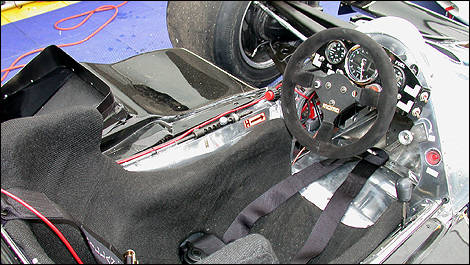 |
| The famous Lotus 79 wing car. (Photo: René Fagnan/Auto123.com) |
The year 2000 marked the introduction of lightweight, super-strong carbon fibre wheels that featured a central display to indicate a variety of settings. The wheel included dozen of electronic components, as well as buttons and switches to modify certain parameters such as the fuel mixture, brake balance, clutch bite point, max revs of the engine and more.
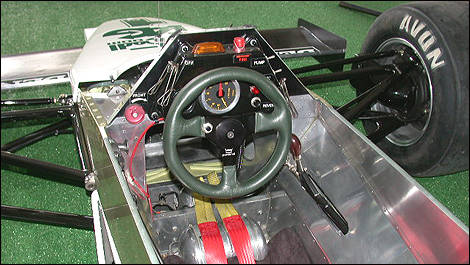 |
| Williams FW08 of the mid-80s. (Photo: René Fagnan/Auto123.com) |
The driver can alter the behavior of the differential with three dials, labeled 'in', 'mid' and 'exit'. These adjust the car's differential to change handling characteristics during the entry, middle and exit of a corner.
What’s most amazing is that drivers are able to manipulate the buttons and switches while driving at speeds exceeding 320 km/h!
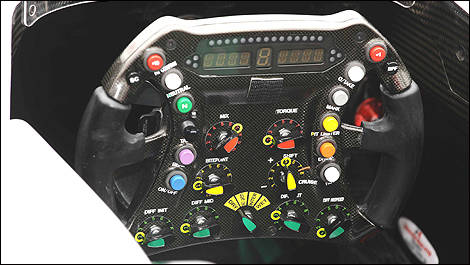 |
| Steering wheels of the Honda F1 car of 2008. (Photo: WRI2) |