





The BioCar Initiative is an Ontario government-funded project designed to advance the use of more plant-based materials in the auto and agricultural industries. Ford holds a spot on BioCar's advisory board and directs some of the project's automotive research with biomaterials.
Issues on the working block include:
- Moisture absorption: Natural fiber-reinforced plastics are more likely to absorb moisture over time, causing functional and durability concerns.
- Odor: Injection molding at high temperatures with a natural fiber-reinforced plastic emits an undesirable odor.
- Decomposition: PLA is designed to decompose quickly, but researchers want to make sure it will last the lifetime of a vehicle before that decomposition process starts.
Experimentation with nano filler materials in plastic composites is still on Ford's research screen, too. Nano fillers have the potential to reduce weight while increasing strength. Early testing shows, in fact, that a plastic reinforced with 5 percent nano filler instead of the typical 30 percent glass filler has strength and lightweight properties that are better than glass. The big roadblock all nano researchers are facing today, however, is how to uniformly exfoliate or disperse the nano material within the composite so that weak spots do not occur.
Here today
Although increased usage of bio-based materials in plastics is still in the advanced research phase, Ford has already made great inroads with other bio-based, reclaimed and recycled materials that are in Ford, Lincoln and Mercury vehicles today.
In addition, Ford also has led the way for other industries to capitalize on its greener material technologies, licensing its soy-based foam to companies such as Deere & Company for agricultural applications. Ford researchers also continue to welcome biomaterial discussions with other non-auto-related manufacturers of items ranging from child car seats to furniture.
photo:Ford
Issues on the working block include:
- Moisture absorption: Natural fiber-reinforced plastics are more likely to absorb moisture over time, causing functional and durability concerns.
- Odor: Injection molding at high temperatures with a natural fiber-reinforced plastic emits an undesirable odor.
- Decomposition: PLA is designed to decompose quickly, but researchers want to make sure it will last the lifetime of a vehicle before that decomposition process starts.
Experimentation with nano filler materials in plastic composites is still on Ford's research screen, too. Nano fillers have the potential to reduce weight while increasing strength. Early testing shows, in fact, that a plastic reinforced with 5 percent nano filler instead of the typical 30 percent glass filler has strength and lightweight properties that are better than glass. The big roadblock all nano researchers are facing today, however, is how to uniformly exfoliate or disperse the nano material within the composite so that weak spots do not occur.
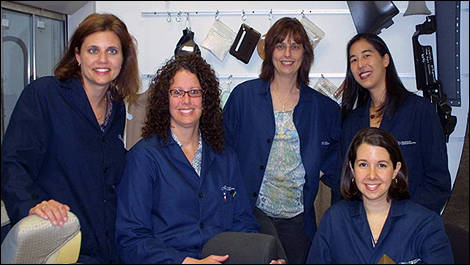 |
| The Ford Research Biomaterials Group (from left): Dr. Cynthia Flanigan, Laura Beyer, Dr. Debbie Mielewski, Dr. Ellen Lee, Angela Harris. |
Here today
Although increased usage of bio-based materials in plastics is still in the advanced research phase, Ford has already made great inroads with other bio-based, reclaimed and recycled materials that are in Ford, Lincoln and Mercury vehicles today.
In addition, Ford also has led the way for other industries to capitalize on its greener material technologies, licensing its soy-based foam to companies such as Deere & Company for agricultural applications. Ford researchers also continue to welcome biomaterial discussions with other non-auto-related manufacturers of items ranging from child car seats to furniture.
photo:Ford