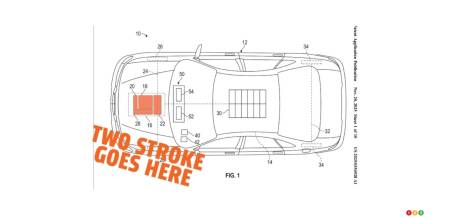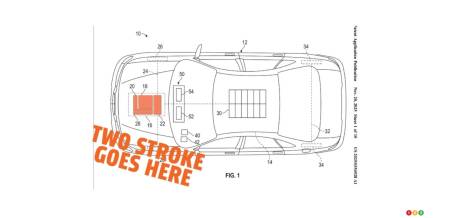



Unless you're a motocross enthusiast, it's highly likely you haven't ben near a two-stroke engine in decades. While their mechanical simplicity, combined with an explosion on every complete revolution, made them zippy, light (and noisy) engines, they fell out of general use due to their excessively high emissions.
Now, General Motors (GM) has gone and filed a new patent application for... a two-stroke engine. The document explicitly mentions use in hybrid vehicles, immediately raising a question: Is GM seriously looking to bring the technology back, for use in a modern context?
A patent focused on durability, not emissions
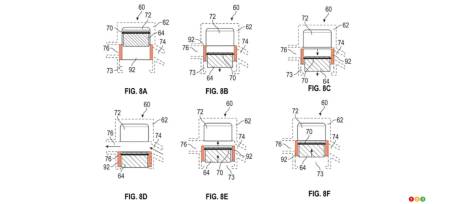
GM’s patent does not directly address the historical primary flaw of two-strokes: the massive quantities of unburnt hydrocarbons expelled through the exhaust. Instead, it proposes a new linear valve system intended to reduce wear on the piston rings, which would improve the lifespan of an engine traditionally known to be temperamental with maintenance.
In a classic two-stroke engine, the intake and exhaust ports are machined directly into the cylinder wall. The piston's movement opens and closes them, while also helping to circulate the air-fuel mixture. Now, GM proposes covering these openings with a valve system that slides inside the cylinder, completely aligned with the wall. The goal is to prevent the rings from rubbing against open orifices, which could improve sealing and compression over time.
Valves in a two-stroke: Not a first
This concept is not completely revolutionary. We’ve seen in the past two-stroke engines equipped with flap valves (called reed valves) or rotary valves, such as those used by Rotax. Here, the linear valves offer slightly finer modulation of the timing, as they can operate independently of the piston's movement.
But more importantly, GM shows in its patent that the intake and exhaust valves move in a synchronized manner. This synchronization promotes scavenging — the clearing of the cylinder to maximize fresh air. But it does not solve the emissions issue that largely doomed two-strokes, and nothing in the patent indicates that GM already has the miracle solution to that issue.
For future commercial use, or just an engineering exercise?
It is possible that GM is preparing complementary technology that could make a two-stroke compliant with current EPA standards. Perhaps an ultra-precise injection system, an advanced catalytic converter or a hybridization strategy that reduces pollutant loads.
But if we rely solely on this patent, we’re still a very long way from the day when that distinctive "ring-ding-ding" sound makes its return to North American roads.