





Consumers will catch on and recognize these technologies are great, but for now, we're putting them out as a response to a problem, not as a response to demand.
J.P.: Some day, will hydrogen, diesel or hybrids take over and make gasoline obsolete?
T.B.: It's too early to pick winners. We caution regulators and lawmakers to not pick winners and losers- and expect that there should be a mix available to let consumers decide. Ultimately, gasoline will be phased out- it comes from fossils and contains carbon, which is the source of pollution. You can't rebuild the supply of gasoline, either. Once the oil well is empty, that's it!
The ultimate solution is a fuel or energy carrier that is more stable.
Gasoline isn't the most stable, it's just the most cost-effective.
J.P.: So, has gasoline reached a certain 'limit'? Are gas-powered engines now as efficient as they'll ever be?
T.B.: They aren't at their limit, and there are improvements that can be
made- but we're at a point where the additional benefits would significantly increase the cost. Incremental improvements come at a very high cost from where we are now.
Interestingly, if gasoline with ultra low sulfur content were available here like it is in Europe, fuel consumption could be improved by 7 to 17 percent with the direct injection technology we're already using.
J.P.: Could there ever be a 500 horsepower M5 that got 50 miles per gallon?
T.B.: Theoretically, it's possible- but you'd need a low-power, low RPM strategy during most driving. Our M5 has a button that adds 100 horsepower- so a 'low power mode' isn't a strong candidate for the M5 customer. And you can't defy the laws of physics, either.
What we're finding is that we need the same performance with smaller engines. Friction is critical- and better economy will happen with less displacement and incredibly improved efficiency, like through turbocharging and supercharging.
We're working to make more power out of less engine size, but there's no magic bullet- and we're using every tool in the toolbox.
J.P.: What can shoppers after clean performance look forward to seeing from BMW in the near future?
T.B.: Our absolute criteria is delivering the ultimate driving experience.
Customers buying a BMW with better mileage, reduced emissions and improved comfort will always get the ultimate driving experience, which defines BMW's Efficient Dynamics philosophy.
The benchmark is established in this regard, and there are no compromises on that. Regardless of changes or improvements, the customer always gets a BMW at the end of the day.
photo:BMW
J.P.: Some day, will hydrogen, diesel or hybrids take over and make gasoline obsolete?
T.B.: It's too early to pick winners. We caution regulators and lawmakers to not pick winners and losers- and expect that there should be a mix available to let consumers decide. Ultimately, gasoline will be phased out- it comes from fossils and contains carbon, which is the source of pollution. You can't rebuild the supply of gasoline, either. Once the oil well is empty, that's it!
The ultimate solution is a fuel or energy carrier that is more stable.
Gasoline isn't the most stable, it's just the most cost-effective.
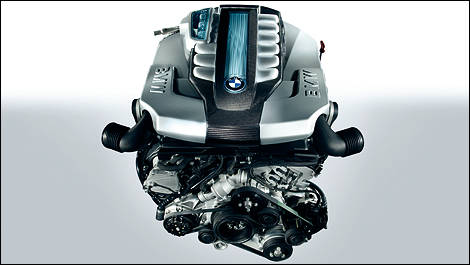 |
| Moteur 12 cylindre à l'hydrogène |
J.P.: So, has gasoline reached a certain 'limit'? Are gas-powered engines now as efficient as they'll ever be?
T.B.: They aren't at their limit, and there are improvements that can be
made- but we're at a point where the additional benefits would significantly increase the cost. Incremental improvements come at a very high cost from where we are now.
Interestingly, if gasoline with ultra low sulfur content were available here like it is in Europe, fuel consumption could be improved by 7 to 17 percent with the direct injection technology we're already using.
J.P.: Could there ever be a 500 horsepower M5 that got 50 miles per gallon?
T.B.: Theoretically, it's possible- but you'd need a low-power, low RPM strategy during most driving. Our M5 has a button that adds 100 horsepower- so a 'low power mode' isn't a strong candidate for the M5 customer. And you can't defy the laws of physics, either.
What we're finding is that we need the same performance with smaller engines. Friction is critical- and better economy will happen with less displacement and incredibly improved efficiency, like through turbocharging and supercharging.
We're working to make more power out of less engine size, but there's no magic bullet- and we're using every tool in the toolbox.
J.P.: What can shoppers after clean performance look forward to seeing from BMW in the near future?
T.B.: Our absolute criteria is delivering the ultimate driving experience.
Customers buying a BMW with better mileage, reduced emissions and improved comfort will always get the ultimate driving experience, which defines BMW's Efficient Dynamics philosophy.
The benchmark is established in this regard, and there are no compromises on that. Regardless of changes or improvements, the customer always gets a BMW at the end of the day.
photo:BMW