





Ever since it moved planned production of the redesigned Jeep Compass from Brampton to the U.S., Stellantis has been looking for a possible use for its currently idle plant in Ontario. Last month, it floated the idea of assembling EVs there with Chinese partner Leapmotor.
Sounds great, except that the plan would include shipping in major parts made in China and carrying out only final assembly – what you would call in complete knockdown form (CKD) – at the Brampton facility. And that, in the view of the federal and Ontario governments and of members of the Canadian auto supply chain, would pose a problem. Two problems, in fact:
- 1) First off, shipping in most parts would obviously hit local Canadian suppliers of parts and components with a body blow;
- 2) Restricting production to CKD would require only a fraction of the work force needed to carry out A-Z production. Unifor Local 1285 president Vito Beato told Automotive News that such a setup would require between 200 and 300 workers at the Brampton plant, barely 10 percent of the workforce that was used to carry out production of the Dodge Charger and Challenger, both previously assembled there.
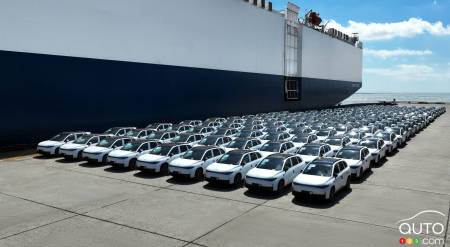
Stellantis has precedent in opting for this strategy. It currently builds the Leapmotor C10 electric SUV for Europe at a plant in Poland, in CKD form. Major components are brought in from China and put together there.
The Canadian government, which had provided financial support to Stellantis in Ontario and did not appreciate the company’ reversal regarding its Jeep Compass, is presently in negotiations with the automaker in a context where lawsuits have been evoked. Coming to some agreement over use of the Brampton plant for Leapmotor production would be a way for the parties to avoid coming to blows. But Ottawa is making clear a deal will not come at the cost of throwing Canadian auto suppliers under the bus.
Stellantis-Leapmotor
Stellantis’ partnership with Leapmotor continues to deepen, with Stellantis holding about 20 percent of Leapmotor shares, and a 51-percent stake in Leapmotor International, the joint venture created to market the Chinese firm’s vehicles outside China. In Europe, Stellantis markets two of Leapmotor’s models – the C10 SUV and the T03 small car – and there are reports of a closer collaboration on the engineering and vehicle development fronts.