





This week has, already, been full of twists and turns. The U.S. President's threatened 25-percent tariffs on imports from Canada were due to take effect today, and they could well have brought auto production to a halt on both sides of the border – some said within a week.
In Canada, Ford, General Motors and Stellantis were considering stopping production (in the worst-case scenario) at their Canadian plants, according to the Canadian Vehicle Manufacturers' Association (CVMA), an organization representing the three major Detroit-based automakers here.
That was reported by Automotive News and it certainly put into sharp focus the impact the tariffs could have had, if imposed.
Uncertainty remains, however, for obvious reasons. The U.S. administration is unpredictable and it could act irrationally. It might yet ignore the barrage of criticism that has spilled forth from leading economists decrying the wrongheadedness of tariffs.
In the U.S., meanwhile, automakers announced that vehicle prices would rise by at least $3,000 USD if tariffs were implemented.
“Everything is possible when you have a tariff of that size. … The whole [auto] supply chain, which has been founded on free and open trade, is suddenly turned on its head,” Brian Kingston, head of the CVMA, told Automotive News.
He added that “The consequences of these tariffs are so devastating across the sector — across North America — it’s hard to imagine a world in which this policy is pursued to its fullest extent.”
Lana Payne, president of the Unifor union that represents Canadian auto workers, said that the threat of tariffs makes this a “very difficult time for auto workers, for our union and for our country”.
Stellantis Canada employs around 4,500 workers at its Windsor, Ontario assembly plant. Some 3,200 normally work at the Brampton assembly plant, currently closed for renovations.
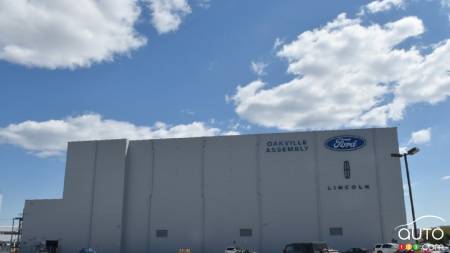
At Ford of Canada, nearly 2,000 workers manufacture engines in Windsor for a wide range of models. Ford's Oakville, Ontario plant, normally has 3,400 workers on the job; here too, the plant is undergoing work to adapt to a new production process.
General Motors Canada has three plants in Ontario, with a total workforce of 5,500.
The CVMA’s Kingston indicated that work in the plants was continuing on the basis of current business rules, but that the automakers were preparing for all eventualities.
As mentioned, the worst-case scenario would be for customs duties to apply not only to finished vehicles, but also to parts which, in some cases, cross the border several times before being installed for the last time in a vehicle.
Beyond the short-term consequences, trade relations between Canada and the U.S. will no longer be the same, at least as long as the current administration is in place.
“That kind of chaos has an impact on future economic decisions for our country, and that means some companies will continue to invest here and some won’t. And that’s a very, very big concern,” added Lana Payne.
What will happen in 30 days? It's impossible to predict. Unpredictability on the part of decision-makers makes planning extremely hazardous and possible very costly. And that is horrible for the markets, which slumped badly early yesterday before recovering after news broke of the postponement of tariffs against Mexico and Canada.