





For those of us who really, really love our cars, taking photos of them is something we dream about. Having that one stellar shot on a poster-size print hanging in the garage is something we long for. Unfortunately, it's not something we often want to pay for. So, instead we pay for a DSLR camera and lens, as well as download a free trial copy of Photoshop and pray it'll all work out.
Or, if you're someone with a job like me, then you're entrusted with the task of taking shots of your press vehicles when you're out and about on the road. These images have to be artistic, show the car in the best light, showcase its best features, and make sure the reader can see the car from every angle while showing where you were and what you were doing. No pressure at all.
I'm a writer. I am not a photographer. Holding my Canon Rebel XTi is stressful for me. It's big, it's heavy and I don't know what 1/2 the buttons do. On the other hand, my husband is a professional photographer. On the weekends, he shoots weddings and when I get a car worthy of his lens, he shoots those too for kicks. His work is stunning—and I'm not just saying that because he gave me a shiny ring. He has an eye. He sees things I don't. He can frame a shot in a way I never in a million years could have imagined.
But then again, under the right conditions, I can spit out a 1,200-word article in less than an hour. Ha. Beat that, photographer.
Back to the matter at hand: Photographing a vehicle. Unlike a person, a vehicle is full of angles, sharp lines and bits and pieces that can catch and swallow light unlike a person. They aren't easy to manipulate or move around. And they also tend to take up a great deal of space.
Over the years, I've learned to accept my photographic ineptitude and inability. I'm no master of the lens, but I have learned enough over the years to scrounge up a decent shot every now and then (and even my production skills after consist of a little contrast/brightness/saturation play and that's it). If you've got an ounce of creativity deep within, you can make your car look like your dream poster, I promise you that.
Our talented photographers here at Auto123.com could tell you much more technical methods about shooting photographs of cars, but I decided I'd give you guys a bit of layman's advice:
First, break out the wash bucket, car soap, hose and get to work. After all, you can't very well go about photographing a dirty car.
Or, if you're someone with a job like me, then you're entrusted with the task of taking shots of your press vehicles when you're out and about on the road. These images have to be artistic, show the car in the best light, showcase its best features, and make sure the reader can see the car from every angle while showing where you were and what you were doing. No pressure at all.
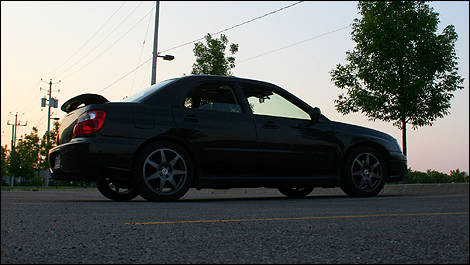 |
| Photo: Miranda Lightstone/Auto123.com |
I'm a writer. I am not a photographer. Holding my Canon Rebel XTi is stressful for me. It's big, it's heavy and I don't know what 1/2 the buttons do. On the other hand, my husband is a professional photographer. On the weekends, he shoots weddings and when I get a car worthy of his lens, he shoots those too for kicks. His work is stunning—and I'm not just saying that because he gave me a shiny ring. He has an eye. He sees things I don't. He can frame a shot in a way I never in a million years could have imagined.
But then again, under the right conditions, I can spit out a 1,200-word article in less than an hour. Ha. Beat that, photographer.
Back to the matter at hand: Photographing a vehicle. Unlike a person, a vehicle is full of angles, sharp lines and bits and pieces that can catch and swallow light unlike a person. They aren't easy to manipulate or move around. And they also tend to take up a great deal of space.
Over the years, I've learned to accept my photographic ineptitude and inability. I'm no master of the lens, but I have learned enough over the years to scrounge up a decent shot every now and then (and even my production skills after consist of a little contrast/brightness/saturation play and that's it). If you've got an ounce of creativity deep within, you can make your car look like your dream poster, I promise you that.
Our talented photographers here at Auto123.com could tell you much more technical methods about shooting photographs of cars, but I decided I'd give you guys a bit of layman's advice:
First, break out the wash bucket, car soap, hose and get to work. After all, you can't very well go about photographing a dirty car.
- Never shoot in the middle of the day when the sun is at its brightest.
- Clouds are your friend.
- Turn your front wheels so you can see the alloys head-on.
- Roll up your windows.
- Consider your background (you don't want trees or poles growing out of your trunk or roof, do you?).
- Look at your background before you look at your foreground (colours, objects, how they correlate with your vehicle).
- Put your camera on the ground and hit the shutter button – trust me, it'll be cool.