





What allows the Carver to tip at such great angles is Vandenbrink's advanced Dynamic Vehicle Control (DVC) system. DVC takes
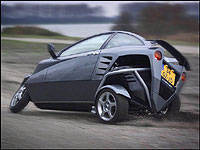 |
| What allows the Carver to tip at such great angles is Vandenbrink's advanced Dynamic Vehicle Control (DVC) system. (Photo: Vandenbrink) |
The Carver is powered by a motorcycle-sized 660-cc turbocharged inline four with four valves-per-cylinder, mated to a regular five-speed manual gearbox. Despite the engine's tiny capacity, and rather meager outputs of 65 horsepower and 74 lb-ft of torque, it's enough to propel the lightweight Carver to 100 km/h in 8.2 seconds. Top speed for this three-wheeled machine is pegged at an estimated 185 km/h. Aside from delivering quick performance, the engine is quite frugal: Vandenbrink claims an estimated 5.5 L/100
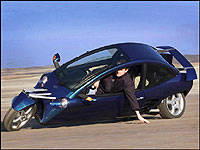 |
| The two-seat Carver holds its occupants in tandem, in racing-style bucket seats due to the body's narrow design. (Photo: Vandenbrink) |
Entry to the cockpit is through conventional doors; however, the layout is anything but conventional. The two-seater Carver holds its occupants in tandem, in racing-style bucket seats due to the body's narrow design. Looking out the tall but narrow front window, which forms part of the roof, one gets the impression that they're in a small aircraft - a feeling that grows once underway from the glasshouse side windows, low seating position, brisk performance and banked cornering abilities. Due to the restrictions of the tandem layout and rear-mounted engine, the rear seat (when not in use) doubles as the trunk and storage space.