





Over the next few weeks, we'll be getting to know the 2026 Kia Sportage HEV. Here is the first chapter of our long-term test of the compact SUV with hybrid powertrain and all-wheel drive.
You only need to look at vehicles around you on the highway or in a crowded parking lot to know that the Kia Sportage is a leading player in one of the leading vehicle segments in Canada. In fact, it’s the most popular segment among gas-powered and hybrid utility vehicles.
For proof, according to figures compiled by the AutoMédia outlet, during the first three quarters of 2025, compact SUVs accounted for 37 percent of new vehicle sales in the province of Quebec.
That category crushed those in second and third spots: full-size pickups took 16 percent of the market, subcompact SUVs 15 percent. That’s from January 1 to September 30, so for the first three quarters of the year.

Heavy competition
Given that the Kia Sportage competes in such a popular segment, it’s hardly surprising the ferocious competition it faces. Everybody has an entrant in the category, everybody has put a lot of effort and resources into that entrant, and everybody is ready to tear each other's eyeballs out to gain market share.
Check out this list of frankly formidable competitors, in order of sales: the Toyota RAV4, followed by the Subaru Crosstrek and Hyundai Tucson — the Sportage’s Korean cousin – and then the Sportage, which sits in fourth place. Behind it, there are no slouches. We find the Honda CR-V, Volkswagen Taos, Nissan Rogue, Mazda CX-5, Ford Escape (for now) and Mitsubishi Outlander.
These are all household names, and all are solid contenders for the throne. The Kia Sportage has no choice but to excel in several of the areas scrutinized by consumers interested in this segment.
And Kia Canada is doing admirably well, given that: for the full year of 2025, it sold 23,906 Sportages in Canada, with more than 38 percent of those sales coming from “La Belle Province” alone.


The right formula
The Sportage’s primary strength is its longevity. Having debuted in 1993, it already has over 30 years under its belt. Three decades have produced five generations—a period long enough to call it a mature vehicle with a proven formula that has evolved to meet the expectations of increasingly demanding vehicle buyers.
Initially, the Sportage was designed on a ladder frame typical of die-hard trucks, but by the second generation, the Korean automaker embraced the trend of SUVs adopting the unibody construction of a sedan, granting them much smoother handling in the process.
With the introduction of the fifth generation in 2021, Kia showed its business savvy by creating two platform lengths: a long version for the North American market (and other countries like Australia) and a short version primarily for the narrower streets of Europe.
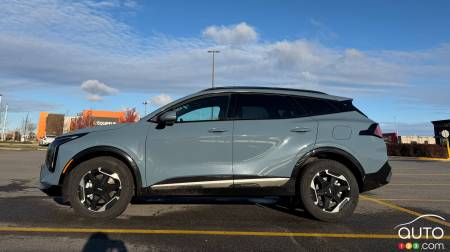
That means that in our market, owners drive a machine that’s 4,660 mm in length and has a wheelbase of 2,755 mm. Comparing these dimensions with the competition reveals that, frankly, everyone is using roughly the same mold:
Model – Length – Wheelbase (mm)
- • Kia Sportage: 4,660 – 2,755
- • Toyota RAV4: 4,595/4,620 – 2,690
- • Subaru Crosstrek: 4,480 – 2,670
- • Hyundai Tucson: 4,641/4,651 – 2,756
- • Honda CR-V: 4,695 – 2,700
- • VW Taos: 4,466 – 2,689/2,680
Within the Kia model universe, the Sportage, flanked on one side by the Seltos subcompact SUV and Niro crossover, and on the other by the bigger three-row Sorento, has been Kia's best-selling model worldwide since 2016, and that includes Canada.
An extensive lineup
Speaking of which, Kia’s Canadian portfolio keeps its aim wide. It may have discontinued the small Rio at the end of 2023, but the automaker didn’t abandon the sedan segment, replacing the Forte with the K4. And at the other end of the spectrum, it still offers the Carnival, one of the few minivans remaining on our market.
But beyond the number of segments it competes in, what truly distinguishes Kia's approach is its strategy of offering a complete range of powertrains: gasoline, hybrid, plug-in hybrid and 100-percent electric.
And so the Sportage can be enjoyed in gas-only, hybrid (HEV) or plug-in hybrid (PHEV) form. And then of course, each has its trims. Here they are for the Sportage in 2026 (prices listed exclude taxes):
Sportage
- • LX FWD ($34,817)
- • LX ($36,917)
- • X-Line ($40,667)
- • EX ($42,667)
- • EX Premium ($44,667)
Sportage HEV
- • HEV EX ($44,217)
- • HEV EX Premium ($47,217)
- • HEV SX ($50,717)
Sportage PHEV
- • PHEV EX ($49,112)
- • PHEV EX Premium ($52,212)
- • PHEV SX ($55,712)
What does all of this add up to? Three models and 11 separate trims with a price spread of about $20,000 between the entry and top levels. Which gives shoppers plenty of options – and plenty to consider - when sharpening their pencils to evaluate their budget and needs.
Next week: Inside the 2026 Kia Sportage HEV SX, the model we drove.
