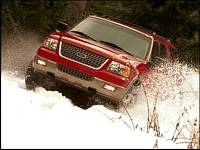
Family matters bring about the subject of safety, an area that Ford has devoted a lot of attention and a fair investment. Active safety features include ABS and Electronic Brake Differential (EBD) equipped brakes with super large 330 mm (13 in) front and 343 mm (13.5 in) rear discs (the largest diameter rotors in its class) and calipers with two times the stiffness of the previous model. This aids both the feel and effectiveness of the brakes. Brake Assist (BA), a technology that applies full braking power in emergency situations even if the driver neglects too is also included.
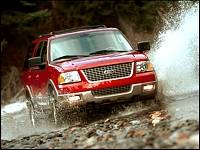
Passive safety features include a new front 'bumper bar' to reduce over-riding onto smaller cars in the case of a frontal accident. This is a similar idea to what sister company Volvo incorporated on its XC90 that recently helped it win a 2003 CAA Pyramid Award for Safety Innovations. Ford's 'Personal Safety System' that uses seat track sensors to configure airbag deployment based on occupant size and crash severity continues over from last year's Expedition as well. The system also employs seatbelt pretensioners, load-limiting retractors, seatbelt buckle sensors, dual-stage driver and passenger front airbags as well as optional curtain airbags. What's more it predicts side-curtain airbag deployment based on electronic rollover sensors that compare the rate of lateral tilt with the rate of lean angle change, and then once deployed inflate for a total of 6-seconds to protect in outside occupants from multiple rollovers.






 Family matters bring about the subject of safety, an area that Ford has devoted a lot of attention and a fair investment. Active safety features include ABS and Electronic Brake Differential (EBD) equipped brakes with super large 330 mm (13 in) front and 343 mm (13.5 in) rear discs (the largest diameter rotors in its class) and calipers with two times the stiffness of the previous model. This aids both the feel and effectiveness of the brakes. Brake Assist (BA), a technology that applies full braking power in emergency situations even if the driver neglects too is also included.
  Passive safety features include a new front 'bumper bar' to reduce over-riding onto smaller cars in the case of a frontal accident. This is a similar idea to what sister company Volvo incorporated on its XC90 that recently helped it win a 2003 CAA Pyramid Award for Safety Innovations. Ford's 'Personal Safety System' that uses seat track sensors to configure airbag deployment based on occupant size and crash severity continues over from last year's Expedition as well. The system also employs seatbelt pretensioners, load-limiting retractors, seatbelt buckle sensors, dual-stage driver and passenger front airbags as well as optional curtain airbags. What's more it predicts side-curtain airbag deployment based on electronic rollover sensors that compare the rate of lateral tilt with the rate of lean angle change, and then once deployed inflate for a total of 6-seconds to protect in outside occupants from multiple rollovers.