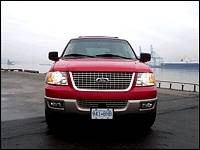
It's a capable performer too. The top-tier Eddie Bauer edition loaned to me for my test week was equipped with Ford's 260-hp 5.4-L Triton V8 putting power through a beefy 4-speed automatic with an overdrive lockout button. The engine's substantial 350 lb-ft of torque, that comes on as low as 2,500 rpm, made for athletic acceleration and no compromise passing maneuvers on the highway. That torque also provides great hauling and towing capabilities, just the kind of partner large SUV customers want - its official payload capacity is 674 kg (1,485) and towing rating of 4,060 kg (8,950 lb) puts it at the top of its category. That said it's a bit of a gas pig at 16.4 L/100 km (14 mpg) combined city/highway compared to the 232-hp (291 lb-ft of torque) base Expedition XLT's hardly green 14.9 L/100 km (16 mpg) combined rating. Power obviously has its price, but at least it's limited to regular unleaded at the pump.
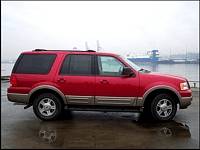
Its ride and handling is much improved over the previous generation Expedition on both high-speed highway stretches and bumpy side roads around town. What did they do to improve it? Its standard 17-inch alloy rims and P265/70R17 AT BSW tires, equipped with a tire pressure monitoring system to warn of under or over inflation, help to iron out the undulations but most of the credit goes to a new independent coil-over-shock double wishbone rear suspension that provides just enough feel to connect the driver to road without being harsh. Handling is also enhanced via widening the SUV's track by 43 mm (1.7 in), improving lateral stability important during emergency lane changes. It's actually surprising how nimble the big SUV feels through the corners, despite its 2,490 kg (5,489 lb) heft.






 It's a capable performer too. The top-tier Eddie Bauer edition loaned to me for my test week was equipped with Ford's 260-hp 5.4-L Triton V8 putting power through a beefy 4-speed automatic with an overdrive lockout button. The engine's substantial 350 lb-ft of torque, that comes on as low as 2,500 rpm, made for athletic acceleration and no compromise passing maneuvers on the highway. That torque also provides great hauling and towing capabilities, just the kind of partner large SUV customers want - its official payload capacity is 674 kg (1,485) and towing rating of 4,060 kg (8,950 lb) puts it at the top of its category. That said it's a bit of a gas pig at 16.4 L/100 km (14 mpg) combined city/highway compared to the 232-hp (291 lb-ft of torque) base Expedition XLT's hardly green 14.9 L/100 km (16 mpg) combined rating. Power obviously has its price, but at least it's limited to regular unleaded at the pump.
  Its ride and handling is much improved over the previous generation Expedition on both high-speed highway stretches and bumpy side roads around town. What did they do to improve it? Its standard 17-inch alloy rims and P265/70R17 AT BSW tires, equipped with a tire pressure monitoring system to warn of under or over inflation, help to iron out the undulations but most of the credit goes to a new independent coil-over-shock double wishbone rear suspension that provides just enough feel to connect the driver to road without being harsh. Handling is also enhanced via widening the SUV's track by 43 mm (1.7 in), improving lateral stability important during emergency lane changes. It's actually surprising how nimble the big SUV feels through the corners, despite its 2,490 kg (5,489 lb) heft.