





Targeting Its Old Market?
What are the power brokers behind the Jeep brand thinking? Are they trying to build the world's largest TJ for entry in the annual monster truck road show?
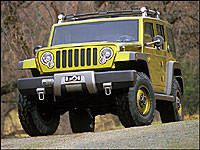 |
| Jeep, the original army vehicle, looks to be considering taking the reins, and big military contracts, away from the now dominant Hummer HUMVEE. (Photo: DaimlerChrysler Canada) |
While that might not be a bad idea for branding the Jeep image on impressionable young minds, the real reason behind this project is a no-brainer. After all, how many "allied offensives" does the U.S. have to take part in before the original army conveyance takes back its rightful place from Hummer?
The Willys Jeep typified the never surrendering spirit that Allied forces embodied during World War II. Today it is an icon, as important to the development of the North American way of life as Ford's Model T and, ironically, Volkswagen's Beetle.
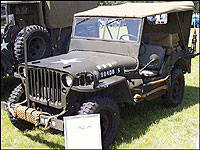 |
| The Willys Jeep typified the never surrendering spirit that American and Allied forces embodied during World War II. (Photo: DaimlerChrysler Canada) |
Now, in case you don't think that today's Chrysler Group is a worthy caretaker of the legendary Jeep heritage, take a look down memory lane to such service oriented notables as the M-4 Sherman tank. Under the direction of Chrysler Corporation President K.T. Keller, Chrysler established the Detroit Tank Arsenal in Warren, Michigan, where 18,000 Shermans, another backbone of the U.S. ground forces, were built.
While Chrysler also built nearly 8,000 "Sea Mule" marine tugs and hundreds of Harbor Utility Tugs at Chrysler facilities for the war effort, Dodge plants delivered close to 500,000 "fighting trucks," primarily for hauling troops and equipment. Of these the M47, M48 Power Wagons and WC6 Command Cars were most notable. Dodge also constructed more than 18,000 Wright Cyclone engines for the B-29 Superfortress, while other plants spewed out gyro-compasses, submarine nets, cooking stoves, practice shells, air raid sirens (for homefront use), smoke screen generators and billions of ammunition cartridges from 1942 through to 1945.