





Powering either transmission is Mitsubishi's impressively upgraded 16-valve, SOHC 2.4-L 4-cylinder engine, with MIVEC valve control. The system, short for Mitsubishi Innovative Valve and lift timing Electronic Control, uses two different cam profiles to optimize the engine's dual intake valves. At 3,500 rpm a more radical lobe engages and the Ralliart pulls with the ferocity of a turbo, but with a much more linear ramp-up of power and more tractable torque curve. Also important, both fuel economy and emissions are improved.
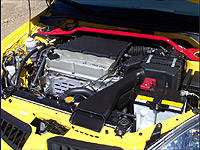 |
| A 162-hp, 16-valve, SOHC 2.4-L 4-cylinder engine, with MIVEC valve control, powers the Lancer Ralliart. (Photo: Trevor Hofmann, Canadian Auto Press) |
While its 162-hp, that peaks at 5,750 rpm, is slightly less than some of its hot competition, that includes the 180-hp VW GTI 1.8T (173 lb-ft of torque), 175-hp Sentra SE-R Spec V (180 lb-ft), 170-hp Ford SVT Focus (145 lb-ft), 170-hp MazdaSpeed Protegé (160 lb-ft), 165-hp Subaru Impreza (166 lb-ft), and 163-hp Mini Cooper S (155 lb-ft), its torque is higher than average, especially if the less powerful Honda Civic SiR.
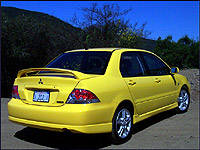 |
| The Ralliart produces 162 lb-ft of torque at 4,000 rpm, which is more than most of its competition. (Photo: Trevor Hofmann, Canadian Auto Press) |
That Honda's horsepower is rated at 160, by the way, respectable enough, but its torque maxes out at only 132 lb-ft. Many people don't realize the importance of torque in everyday driving. It improves acceleration, smoothes out shifts and generally makes for a more manageable car. The Lancer Ralliart's 162 lb-ft of torque, maximizing at a relatively low 4,000 rpm, places it near the top of this group.
The Ralliart's output ratings are only 2-hp and 2 lb-ft of torque higher than the less sport-oriented Lancer LS, which goes to show the Japanese automaker supports its sporty brand image even on lesser models. The slight bump in output is achieved by the addition of a freer-flowing exhaust system that includes a larger-diameter exhaust pipe, plus a high-volume catalytic converter and muffler. The result is reduced engine backpressure which in-turn frees up performance.