





Hardly lacking in importance, a rigid body is paramount when trying to achieve ultimate control. Mitsubishi added diagonal braces from the outer strut towers to the cowl at the A-pillars, dramatically improving structural soundness. Also, a tubular 3-point front strut-tower brace ties both sides together, while sporting a stylish red paint job.
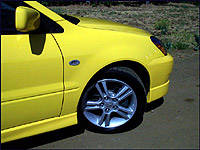 |
| The Ralliart's 16-inch wheels are a good compromise, benefiting both handling and ride while keeping costs within reason. (Photo: Trevor Hofmann, Canadian Auto Press) |
Some of the improvement in handling must go to the larger diameter 16-inch Euro-flange aluminum wheels covered with 205/50R16 all-season performance tires, up from the 195/65R15 tires that come standard on less sporting Lancer models. While a few competitors offer 17 and even 18-inch wheel and tire packages, others only offer 15s. I think the Ralliart's 16-inch solution is a good compromise benefiting both handling and ride, while keeping costs within reason.
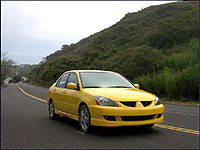 |
| The Ralliart's impressive brakes help it feel like a rally car, with near perfect responsiveness. (Photo: Trevor Hofmann, Canadian Auto Press) |
While speeding around the mountains of Southern California and the winding highways that span the coastline's beach communities, the Lancer Ralliart's upgraded brakes were much appreciated. Discs are at all four corners, measuring 277 mm (10.9 inches) at the front and 262 mm (10.3 inches) in the rear. The caliper piston diameters are up 5.8 mm (0.23 inches) from stock models, while brake booster capacity has also been increased. Not only do the brakes react instantaneously to immediate input, but they offer terrific feel with very little fade when aggressive braking is repeated over and over. The addition of optional ABS and Electronic Brake force Distribution (EBD) doesn't hamper stopping distances either.
Such impressive braking helps it to feel like a rally car, especially through mountain stretches. I was able to get hard on the throttle coming out of a sharp curve without the worry of lackluster brake performance before entering the next corner. The little Lancer allowed rhythmical operation, near perfect responses to often less than perfect driver input.