The exterior stylings of the MR2 Spyder do resemble those of the Porsche Boxster, but the engine unfortunately does not. Powering the sultry convertible is a 1.8-litre,
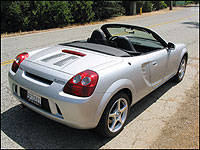 |
| Powering the sultry convertible is a 138-hp 1.8-litre, 16-valve, DOHC VVT-I SFI 4 cylinder engine. (Photo: Alexandra Straub, Canadian Auto Press) |
16-valve, DOHC VVT-I SFI 4 cylinder engine producing 138 horsepower at 6,400 rpm and 125 lb-ft of torque at 4,400 rpm. I found that there was decent power in the Spyder but I wanted a little more. After all, it looks sporty, acts sporty and is sporty but when I was getting passed by a Corolla, I felt a little inadequate. My feeling of inadequacy also could have stemmed from the fact that I was obeying the posted speed limits. If it were up to me, I would drop a 180 hp
Celica GT-S engine into the MR2 Spyder to give it more power and pizzazz. My test car included the standard five-speed manual transmission which
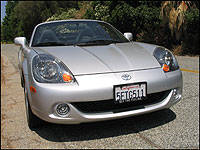 |
| The mid-engine rear-wheel drive setup of the Spyder is ideal for stability. (Photo: Alexandra Straub, Canadian Auto Press) |
made for a decent 0 to 60 mph time of 6.9 seconds. The shifts were relatively short and definitely smooth. It was an agreeable car to drive right from the get go. In general I prefer manually shifting gears, but for those who don't an optional 6-speed sequential manual transmission with steering wheel-mounted shift buttons can be ordered instead. Handling is superb, probably even better than the MazdaSpeed Miata I previously tested. The mid-engine rear-wheel drive setup is ideal for stability in tight turns, yet it's not too punishing, resulting in a comfortable enough ride for long road trips.