A virtue common among BMWs is solid build quality, and as such the X3 falls close to the tree. I was not only impressed with the solidity of its
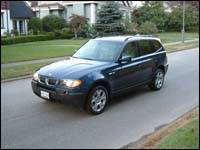 |
| A virtue common among BMWs is solid build quality, and as such the X3 falls close to the tree. (Photo: Rob Rothwell, Canadian Auto Press) |
construction, both inside and out, but was particularly won over by the secure feeling the X3 imparts when contending with rough roads and disintegrating pavement. Running the junior SUV over the roughest roads I could find proved it to be a rattle-free experience. Pleasantly, my tester produced no evidence of body shudder or undesirable suspension noise.
It did, however, produce some refined, but rather audible tones from its optional 3.0-litre (182 cu in), 24-valve inline 6-cylinder powerplant, capable of generating 225-horsepower at 5,900 rpm and 214 foot-pounds of torque at 3,500 rpm. But auditory sensations aside, considering this mill is the X3's bad-boy engine its motivating force wasn't overly impressive. The X3's base engine is a 2.5-litre (152 cu in) I-6 churning out 184-horsepower and 175 foot-pounds of twist. Given the 1,825 kg (4,023 lb) curb weight of the X3, neither engine is palpitation inducing when it comes to off-the-line
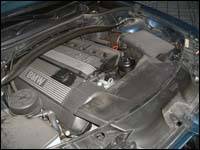 |
| A respectable level of torque arrives early and stays throughout the rev band, effortlessly carrying the large- and heavy-for-a-compact SUV up mountain highways with confidence. (Photo: Rob Rothwell, Canadian Auto Press) |
acceleration, but the bigger guy is definitely capable of raising an eyebrow or two once underway. Where the 3.0-litre shines brightest is on hills. Its respectable torque rating arrives early and stays throughout the rev band, effortlessly carrying the large- and heavy-for-a-compact SUV up mountain highways with confidence.
This is an engine that likes to rev and proves it when snappy passing power is needed to move safely ahead of a lumbering semi on the highway. The 6-speed manual gearbox in my tester allowed me to make the most of the engine's broad torque curve, by assigning the 'right gear at the right time'. The Beemer's stick slotted from cog to cog with fairly long throws guided by a "notchy" precision that left little doubt about which of the six cogs was on stage next. Clutch take-up was on the grabby side, requiring some concentration to achieve smooth hook-ups.