


Auto123.com - Helping you drive happy

2005 Dodge SRT-4 Road Test

|
Obtain the best financial rate for your car loan at Automobile En DirectTecnic
Khatir Soltani
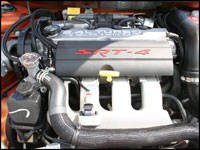
The heart of the matter, and what the SRT-4 will be best known for, is its 2.4-litre DOHC I-4 turbo. (Photo: Justin Couture, Canadian Auto Press)
As far as I can remember, the first generation Neon (the SX 2.0's predecessor) was a remarkable handler. It might not have had the same feel-good interior as latter day Hondas or VWs, but in the right hands no new car on the flip side of $30,000, aside from the Mazda Miata was quicker through the cones at an autocross. It was also a consistent performer in budget car comparison tests in most magazines, particularly in R/T or ACR trim. The SRT-4 takes everything anyone ever knew about the Neon's handling abilities and cranks it up to eleven. PVO tweaked the already capable steering slightly, adding new front suspension knuckles, revising overall geometry, increasing the front sway bar to 24 mm (0.94 inches). Also fitted are Tokico dampers with higher-rate springs to snuff body roll. Brakes have also been upgraded with larger four-wheel discs and extremely powerful single-piston calipers.

The heart of the matter, and what the SRT-4 will be best known for, is its 2.4-litre DOHC I-4 turbo. This is the most powerful application of the turbo-four, which is also featured in the PT Cruiser and Mexican-market 'cloud' cars (Stratus, Cirrus). As a part of last year's update, the SRT-4 now makes 230-horsepower and 250 lb-ft of torque, some 15 horses and
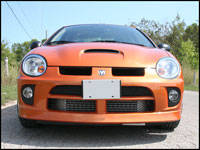
The SRT-4 now makes 230-horsepower and 250 lb-ft of torque, some 15 horses and 5 lb-ft of torque more than when it first appeared. (Photo Justin Couture, Canadian Auto Press)
5 lb-ft of torque more than in its first appearance. It trounced the major competition and many sports cars that cost thousands of dollars more.

The gain in power is attributed to new fuel injectors, which are able to supply the hungry engine with more fuel. Prior to the adjustment, Dodge found that at high revs the engine was starved for fuel, causing it to run lean. To prevent permanent engine damage in those instances, the computer cut the turbo's boost. The difference isn't noticeable from inside the cabin, but it's present in the figures, being some 0.3 seconds quicker to 100 km/h (5.5 seconds) than before.
Khatir Soltani
Khatir Soltani
Automotive expert
  • Over 8 years experience as a car reviewer
  • Over 50 test drives in the last year
  • Involved in discussions with virtually every auto manufacturer in Canada