





Variable valve timing (or VVT, for short) has been around since the early '90s, a prominent feature of performance-minded Hondas
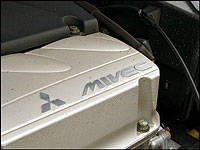 |
| The biggest advantage which the Ralliart packs is MIVEC, Mitsubishi's variation on variable valve timing. (Photo: Justin Couture, Canadian Auto Press) |
Based on this idea, Mitsubishi decided that having three profiles is better than two, and so the Lancer has individual cams for low, medium and high-lift situations. Having different profiles is a little bit like having more gears in a transmission; certain profiles benefit certain driving conditions, and can improve performance, as well as combustion. The
 |
| The bigger engine and MIVEC give the Ralliart a different character than the typical sport compact. (Photo: Justin Couture, Canadian Auto Press) |
The bigger engine and MIVEC give the Ralliart a different character than the typical sport compact. With a larger bore and stroke, you might be surprised to find that power and torque figures are not only comparable, but identical at 162-horsepower, and 162 lb-ft of torque. There's no massive torque deficit as with high-strung Honda-Acura VTEC motors, or Toyota's VVTi-L powered Celicas, Matrixes and Corollas. Flexing your right ankle brings forth the Lancer's respectable wave of torque, regardless of whether you're above or below the low-ish high-profile switchover point of 3,500 rpm, leaving the competition behind in a wake of the aurally pleasing burble from its stainless steel exhaust.