





First and second row seats are fairly comfortable. The second row is comprised of captain chairs. On the other hand, the third row bench has very firm cushions and should only be used when there are no other options. Leg and headroom is very generous.
Cubby holes are everywhere in the Relay's vast cabin. Attached to the seatback of both front row seats are flip-out storage bins and our tester had the optional hideaway rear containers and the overhead storage compartments on rails. The main problem with the ceiling mounted bins is that headroom is reduced when crossing from the front to the second row (I hit my head twice...). The extendable foldaway trays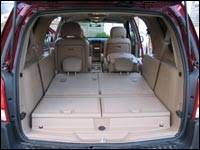 between the captain chairs are very useful.
Unlike every other manufacturer (not sure about the new Sedona), the Relay's third row bench does not tumble back into the floor of the trunk. Instead, it folds flat forward in one motion. It may sound good, however the cargo floor is much higher than the others. Also, the useful hole in the cargo floor for the tumble third row bench, not found in this van, is replaced by some shallow storage basically created to level the cargo area.
Technical
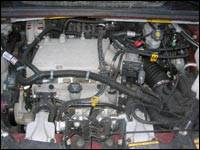
There is only one engine available for the Relay. It is an OHV 3.5L V6 that develops 200 hp at 5 200 rpm and 220 lb/ft of torque at 4 400 rpm. The transmission is an electronically controlled 4-speed automatic and it can
be mated to either a FWD setup or an AWD drivetrain called Versatrak. The FWD models have a front independent and rear semi-independent suspension whereas the AWD has a fully independent suspension. They are all equipped with 4-wheel disc brakes.
On the road
The new 3.5L engine is a little short on power, especially when compared to the competition and because of the extra weight of the AWD system. Surprisingly though, fuel consumption is somewhere between a reasonable 14.0 L and 14.5 L per 100 km. Speed and acceleration, to use the words lightly, progress slowly. The meagre output of the engine is sufficient for the minivan itself, although I can hardly imagine what it would be like loaded with gear, the family, and towing a 1 588 kg trailer.
The automatic transmission works nicely. It functions as well as any automatic transmission found in all GM vehicles: it upshifts crisply, kickdowns are brisk and its operation is very smooth overall. The Versatrak AWD system of the tester left me very disappointed. The front wheels must spin quite a bit before the rear differential does its work. What basically happened when all four wheels were engaged was a drop in engine rpm and a slow progression forward.
Steering is ghastly; it is over-assisted, has no on-centre feel, lacks all form of precision and it gets worse once on the highway. Constant adjustments and corrections are needed to keep the Relay going in a straight line. The brakes are another sore point. The 4-wheel discs seem to have a hard time dealing with the weight of the van. The pedal itself is firm however the initial bite from the pads is non-existent. To come to a full stop, the pedal requires tremendous effort. Considering that the AWD versions have an independent rear suspension, one would expect a reasonably compliant ride. The fact is that the Relay has a very harsh and unpleasant ride. The front-end shakes enormously and the vibrations are transmitted through the steering wheel and into the cabin. I think the 17" wheels may partially be at fault. It would probably be better off with 16" wheels.
Cubby holes are everywhere in the Relay's vast cabin. Attached to the seatback of both front row seats are flip-out storage bins and our tester had the optional hideaway rear containers and the overhead storage compartments on rails. The main problem with the ceiling mounted bins is that headroom is reduced when crossing from the front to the second row (I hit my head twice...). The extendable foldaway trays
 between the captain chairs are very useful.
 Unlike every other manufacturer (not sure about the new Sedona), the Relay's third row bench does not tumble back into the floor of the trunk. Instead, it folds flat forward in one motion. It may sound good, however the cargo floor is much higher than the others. Also, the useful hole in the cargo floor for the tumble third row bench, not found in this van, is replaced by some shallow storage basically created to level the cargo area.
Technical
There is only one engine available for the Relay. It is an OHV 3.5L V6 that develops 200 hp at 5 200 rpm and 220 lb/ft of torque at 4 400 rpm. The transmission is an electronically controlled 4-speed automatic and it can
 |
On the road
The new 3.5L engine is a little short on power, especially when compared to the competition and because of the extra weight of the AWD system. Surprisingly though, fuel consumption is somewhere between a reasonable 14.0 L and 14.5 L per 100 km. Speed and acceleration, to use the words lightly, progress slowly. The meagre output of the engine is sufficient for the minivan itself, although I can hardly imagine what it would be like loaded with gear, the family, and towing a 1 588 kg trailer.
The automatic transmission works nicely. It functions as well as any automatic transmission found in all GM vehicles: it upshifts crisply, kickdowns are brisk and its operation is very smooth overall. The Versatrak AWD system of the tester left me very disappointed. The front wheels must spin quite a bit before the rear differential does its work. What basically happened when all four wheels were engaged was a drop in engine rpm and a slow progression forward.
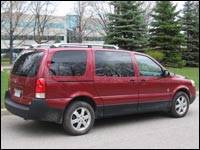 |
Steering is ghastly; it is over-assisted, has no on-centre feel, lacks all form of precision and it gets worse once on the highway. Constant adjustments and corrections are needed to keep the Relay going in a straight line. The brakes are another sore point. The 4-wheel discs seem to have a hard time dealing with the weight of the van. The pedal itself is firm however the initial bite from the pads is non-existent. To come to a full stop, the pedal requires tremendous effort. Considering that the AWD versions have an independent rear suspension, one would expect a reasonably compliant ride. The fact is that the Relay has a very harsh and unpleasant ride. The front-end shakes enormously and the vibrations are transmitted through the steering wheel and into the cabin. I think the 17" wheels may partially be at fault. It would probably be better off with 16" wheels.