 |
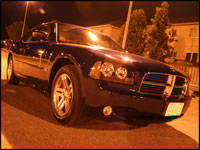
| The V6 is good enough to slingshot this full-size sedan to 100 km/h in a respectable 7.5 seconds. (Photo: Justin Couture, Canadian Auto Press) |
Speaking of that V6, the Charger SXT is powered by a high-output 3.5-liter dual overhead cam V6 which produces 250-horsepower and 250 lb-ft of torque. Used in other LX-chassis cars, it's a mid-range engine that features smooth power delivery. Never once did the car's 1,723 kg (3,800 lb) curb weight burden the engine; its near-flat torque curve meant that power was constantly on demand, and no more than an ankle-flex away. While you won't be able to perform the same tire-smoking burnouts as possible in the more powerful HEMI-powered Chargers, the V6 is good enough to slingshot this full-size sedan to 100 km/h in a respectable 7.5 seconds, quicker than its svelte figures suggest. Fuel economy is rated at 12.5 l/100 km (23 mpg) in the city, and 8.1 l/100 km (35 mpg) on the highway. After five day's worth of testing, I managed to average 11.7 l/100 km (24 mpg), a figure acceptable for a mix of open-stretches of road and wading through long-weekend traffic, and darn pleasing for a full-size sedan.
Directly above the V6 in the engine hierarchy is a pair of highly impressive HEMI V8s. Standard to the R/T and the matte-black stickered R/T Daytona is the 5.7-litre twin-spark unit, with MDS cylinder deactivation. In R/T guise, it makes 340-horsepower, while the R/T Daytona's freer-flowing exhaust and intake manifold liberates an additional 10 horses, accompanied by a tough-as-nails soundtrack. As far as market values go, there's no cheaper way into the HEMI family than the Charger R/T, which ticks in at just over 37 grand. For the ultimate Charger, the SRT8, the HEMI goes on steroids, bulking up to a massive 6.1 litres in displacement for a total of 425 pavement-melting horses. All V8s are routed through a five-speed automatic gearbox; unfortunately no manual is available.
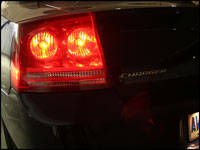 |
| Kudos must go to Stuttgart for the three-pointed star's role in initially orchestrating the suspension and steering - previously used for the E-Class. (Photo: Justin Couture, Canadian Auto Press) |
But back the car most Charger buyers will purchase, one noteworthy powertrain specification that separates the SXT model from the mid-level 3.5-litre V6-powered 300 and Magnum is the fact that the up-level 5-speed AutoStick automatic gearbox is standard equipment. The others, in rear-wheel drive form, must contend with a four-speed version. Shift action is of Mercedes-Benz quality, which comes as no surprise; after all, this is derived from a Mercedes-Benz gearbox. Strangely, if you're not used to the M-B gearbox that is, the AutoStick mode, toggled by a moving the leather-wrapped shift knob from side to side, has a mind of its own, pausing for a second or two before allowing the message of full, afterburner thrust to hit the engine.