





Problem or not, its cargo capacity is sizable, and especially useful for young families with only a single child or none at all (enjoy that
while you can by the way), or for that matter grandparents who might only use the rear seats when taking little Bobby and Suzy (or to be more up with the times, little Jacob and Emily) to the zoo.
So it's accommodating, but how does it drive? Toyota offers features normally only available on larger cars, again in an attempt to help buyers rethink the subcompact segment. What do I mean? How about available ABS, an extra that only Hyundai's Accent shares in its class. OK, the Accent also offers rear discs, exclusive to the category, which is a bonus for sure, but none of the others come close as far as braking goes.
In case you were wondering, Toyota is up against some bargain basement regulars, being that Hyundai Accent just mentioned and the Kia Rio which shares much of its components and general undercarriage, plus a
few newer players, which comprise the GMDAT (GM Daewoo Auto & Technology) Chevrolet Aveo, Pontiac Wave and Suzuki Sprint+ trio. That makes the Yaris the only Japanese vehicle in the bunch, if that matters to you, the others (yes even the "Heartbeat of America" Chevy) all made in Korea.
The Yaris is also slightly lower in power than the Hyundai and Kia models, by a mere 4-horsepower at 106 compared to 110, but you'd have to have acute perception to notice any difference under acceleration. It's actually a blast at full throttle, with enough pull on the front wheels in second gear to spin the tires, no less. But that would be irresponsible, no? I suppose the Yaris brought that not-so-dormant adolescent side of me out into the open, especially during a handling test that Toyota had set up in a little used parking lot... you know the drill: orange cones, a short straight, bunch of tight corners, high-speed slalom and then a brake test.
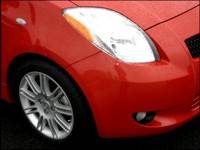 |
| The Yaris offers optional ABS, an extra that only Hyundai's Accent shares in its class. (Photo: Trevor Hofmann, Canadian Auto Press) |
So it's accommodating, but how does it drive? Toyota offers features normally only available on larger cars, again in an attempt to help buyers rethink the subcompact segment. What do I mean? How about available ABS, an extra that only Hyundai's Accent shares in its class. OK, the Accent also offers rear discs, exclusive to the category, which is a bonus for sure, but none of the others come close as far as braking goes.
In case you were wondering, Toyota is up against some bargain basement regulars, being that Hyundai Accent just mentioned and the Kia Rio which shares much of its components and general undercarriage, plus a
 |
| The Yaris is a blast at full throttle when pulling away from a stop, with enough pull on the front wheels in second gear to spin the tires. (Photo: Trevor Hofmann, Canadian Auto Press) |
The Yaris is also slightly lower in power than the Hyundai and Kia models, by a mere 4-horsepower at 106 compared to 110, but you'd have to have acute perception to notice any difference under acceleration. It's actually a blast at full throttle, with enough pull on the front wheels in second gear to spin the tires, no less. But that would be irresponsible, no? I suppose the Yaris brought that not-so-dormant adolescent side of me out into the open, especially during a handling test that Toyota had set up in a little used parking lot... you know the drill: orange cones, a short straight, bunch of tight corners, high-speed slalom and then a brake test.