Many Volkswagen owners are attracted to the brand by the taut handling characteristics of their vehicles, and the Passat is no
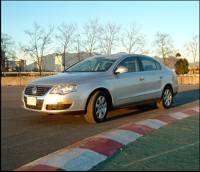 |
| Few midsize family sedans can zig zag quite as competently as the Passat while maintaining a comfortable ride. (Photo: Rob Rothwell, Canadian Auto Press) |
exception. Few midsize family sedans can zig zag quite as competently as the Passat while maintaining a comfortable ride. The underpinnings connecting the new VW to its wheels perform a remarkable job of keeping the car stable during evasive maneuvers and emergency stops, with very little nosedive or body roll accompanying either shift in inertia. The Passat shares much of its underbody architecture with the smaller Jetta, both of which utilize MacPherson struts up front and a 4-link independent setup out back with stabilizer bars in place fore and aft.
The cumulative effect of the suspension arrangement and the calibration VW's engineers have applied therein results in sports-car-like stability throughout corners, sans barbaric treatment of occupants. But don't be lulled into believing the 2006 Passat rides on a cloud, it doesn't. Its connection to the roadway feels tight, giving plenty of feedback to the driver rather than the isolation some slushier-r
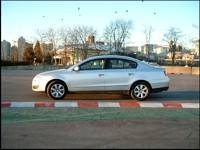 |
| The Passat 2.0T's connection to the roadway feels tight, giving plenty of feedback to the driver rather than the isolation some slushier-riding sedans impart. (Photo: Rob Rothwell, Canadian Auto Press) |
iding sedans impart. The Passat's road-feel may not be what the "Buick" crowd is looking for, although I suggest they would be looking for the powerful, fade-free stopping ability generated by the Passat's 4-wheel antilock disc brakes.
In addition to strong braking, those same folks would most certainly seek solid build quality and topnotch interior fit and finish. Here again the Passat is entitled to bragging rights. Volkswagen has done a marvelous job of accurately assembling a first class cabin using high quality materials. Unattractive hard plastic is almost non-evident throughout the spacious living area. The logical layout of the Passat's instrument panel, combined with its straightforward switchgear, makes for easy usage; an example of which are the single-purpose
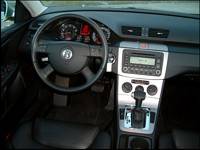 |
| The logical layout of the Passat's instrument panel, combined with its straightforward switchgear, makes for easy usage. (Photo: Rob Rothwell, Canadian Auto Press) |
knobs used to adjust treble, bass and midrange settings. As a bit of an audiophile, finding that Volkswagen maintained this arrangement on the Passat for 2006 was indeed refreshing, as was the retention of the three rotary dials assigned to HVAC duties (base single-zone climate control).
My tester featured the base model's leatherette seating, which during the winter is tremendously inviting once the five-position heat setting hits its upper reaches. Although these front buckets were not the most supportive VW seats I have ever encountered, they served their intended purpose with suitable poise. Sliding the front seats back demonstrated the extra length VW has built into the Passat's cabin. Legroom up front and in the rear has been extended for 2006, and is darn plentiful, but the enhanced interior space
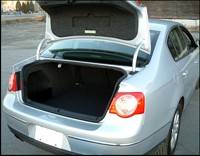 |
| Oddly, trunk space has diminished from 425 litres (15 cu ft) in 2005 to 402 litres (14.2 cu ft in) in the new 2006 model, with VW's new 2006 Jetta offering more volume at 500 litres (17.7 cu-ft). (Photo: Rob Rothwell, Canadian Auto Press) |
has been invoiced against trunk space, which has diminished from 425 litres (15 cu ft) in 2005 to 402 litres (14.2 cu ft in) 2006 - odd being that the 2006 Jetta, also totally revised, offers more trunk space at 500 litres (17.7 cu-ft), than even last year's Passat. However, extra invoicing isn't necessary to fill the Passat with cutting-edge occupant protection and crash-avoidance installations.
Standard occupant protection includes frontal airbags for the driver and front passenger in addition to driver and front passenger thorax airbags. Thorax airbags for rear seat passengers are optional but not side-curtain protection, which cushions craniums in all outboard seating positions. The driver and front seat passenger also benefit from crash-active head restraints and seatbelt pretensioning. Of course, avoiding a crash in the first place is preferable to surviving one. For this reason VW has included its Anti-Slip Regulation (ASR) traction control system and Bosch's Electronic Stabilization Program (ESP) stability technology as standard equipment.