Inside the car, it immediately became apparent that even the recently released all-new subcompacts made by rival brands needed
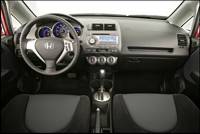 |
Aptly, fit and finish is superb, and the car's plastics quality, on the dash, console, armrest, door sills, and pretty well everywhere else, is easily best in class. (Photo: Honda Canada)
|
to step up their game before April, if they expect to be seen in the same light as Honda's Fit when it debuts. Aptly, fit and finish is superb, and the car's plastics quality, on the dash, console, armrest, door sills, and pretty well everywhere else, is similar to that inside the larger, more expensive Civic - that car one of the best in the more upscale compact class.
Switchgear is also impressive, with tightly fitting buttons and knobs that don't wiggle sloppily back and forth at all, unlike some premium cars. The Fit's seats are impressive too, both comfortable and seemingly supportive, although a long drive will be needed in order to make certain of this first impression.
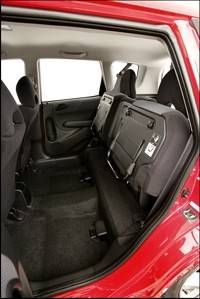 |
| Honda's rear seating system is so flexible that it has given it a name, "Magic Seat". (Photo: Honda Canada) |
One thing that was immediately clear, however, was rear seat spaciousness. The Fit's tall roofline won't make rear seat passengers suffer, and with that expands its usability among subcompact buyers.
Cargo room is also generous at 603 litres (21.3 cu-ft) of volume when the rear seatbacks are upright, which is just a bit less than Honda's Element offers aft of the rear seats and well over twice as much as Toyota's five-door Yaris at 228 L (8.1 cu ft) of cargo area. How do they do it? Ingeniously, Honda located the fuel tank in a central location towards the middle of the vehicle, rather than in back where it causes the floor space to be raised. The Fit's floor is lower than average, allowing for the extra room. Additional space can be had by dropping the 60/40 split folding rear seatbacks forward, although Honda hasn't come forward with any exact specifications. But that's not all it can do. Honda's rear seating system is so flexible that it has given it a name, "Magic Seat", and thanks to seatbacks that not only fold down to open up the cargo area, but also allow the lower cushions to pop up and expose a cavernous mid-section that looks fabulous for bikes (you've really got to see all of the photos in the gallery
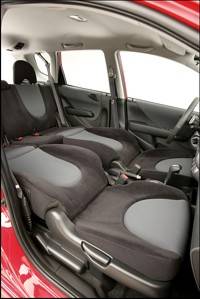 |
| Drive-in movie anyone? The Fit's rear seating area can turn into two loungers or even a bed in a pinch. (Photo: Honda Canada) |
as my description hardly does it justice), as well as front seats that fold rearward and butt up against the rear cushions to form a bed or rear seat lounge area, resulting in four individual passenger and cargo configurations that Honda dubs refresh mode, tall object mode, long object mode and utility mode. Cool.
Altogether, considering its subcompact exterior dimensions, measuring 3,999 mm (157.4 inches) long, 1,682 mm (66.2 inches) wide, 1,524 mm (60.0 inches) tall, and features a wheelbase that spans 2,450 mm (96.5 inches), the Fit is impressively roomy inside with 2,551 litres (90.1 cu-ft) of passenger volume; which by the way is only slightly less than a midsize Accord's passenger volume.
That spaciousness will be generously outfitted with standard features too, such as an AM/FM/CD audio system, power windows and a two-tone interior, while a number of upgrades will also be available, as well as Honda Genuine Accessories will be made available at the dealership level, to help new buyers personalize their cars.