





Although front seat occupants will bask in open space, adults of large proportion held captive for long durations in the rear seat may plan a coup to relocate due to limited leg and headroom therein. Kids in the rear won’t feel any such provocation.
The rear cargo bay of the Golf wagon is accessed through a large liftgate that rises well out of the way enabling easy loading at the utility end of the vehicle. Two expansive, shallow storage wells can be accessed beneath the hinged floor panels.
Overall, cargo accommodation has been well thought-out.
Making it move
Plenty of power is generated beneath the hood by an inline 2.5-litre 5-cylinder gas engine. This smooth, somewhat curious mill is not the quietest engine by far but it’s more refined and responsive than a typical 4-banger while achieving similar fuel economy.
With a maximum output of 170 horsepower @ 5,700 rpm and 177 pound-feet of torque @ 4,250 rpm headed to the front wheels, the Golf Wagon is no gutless econobox—far from it in fact. Passing performance on the highway is outstanding for this class of automobile, which is reassuring. That’s not always the case with compact economy cars.
Another very good, and more fuel efficient, engine choice is the optional 2.0-litre turbodiesel TDI. Although its horsepower rating is far below its gas cousin, its wealth of torque more than makes up for a few less hooves kicking the dirt.
For buyers with easy access to diesel pumps, I recommend opting for the diesel alternative.
Regardless of engine choice, the smooth ride will please
One of the highlights that I take away from my time with the Golf Wagon is its remarkably smooth ride combined with its athletic handling verve; it’s an enjoyable combo that doesn’t come steaming hot in a circular tinfoil pan with a cardboard lid—that’s a different highly enjoyable combo.
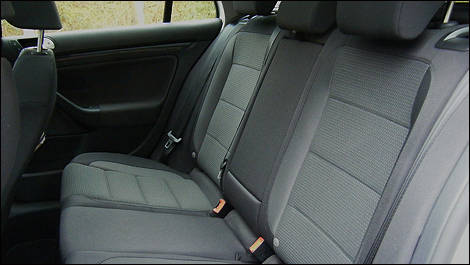 |
| Although front seat occupants will bask in open space, adults of large proportion held captive for long durations in the rear seat may plan a coup to relocate due to limited leg and headroom therein. (Photo: Rob Rothwell/Auto123.com) |
The rear cargo bay of the Golf wagon is accessed through a large liftgate that rises well out of the way enabling easy loading at the utility end of the vehicle. Two expansive, shallow storage wells can be accessed beneath the hinged floor panels.
Overall, cargo accommodation has been well thought-out.
Making it move
Plenty of power is generated beneath the hood by an inline 2.5-litre 5-cylinder gas engine. This smooth, somewhat curious mill is not the quietest engine by far but it’s more refined and responsive than a typical 4-banger while achieving similar fuel economy.
With a maximum output of 170 horsepower @ 5,700 rpm and 177 pound-feet of torque @ 4,250 rpm headed to the front wheels, the Golf Wagon is no gutless econobox—far from it in fact. Passing performance on the highway is outstanding for this class of automobile, which is reassuring. That’s not always the case with compact economy cars.
Another very good, and more fuel efficient, engine choice is the optional 2.0-litre turbodiesel TDI. Although its horsepower rating is far below its gas cousin, its wealth of torque more than makes up for a few less hooves kicking the dirt.
For buyers with easy access to diesel pumps, I recommend opting for the diesel alternative.
Regardless of engine choice, the smooth ride will please
One of the highlights that I take away from my time with the Golf Wagon is its remarkably smooth ride combined with its athletic handling verve; it’s an enjoyable combo that doesn’t come steaming hot in a circular tinfoil pan with a cardboard lid—that’s a different highly enjoyable combo.
 |
| The rear cargo bay of the Golf wagon is accessed through a large liftgate that rises well out of the way enabling easy loading at the utility end of the vehicle. (Photo: Rob Rothwell/Auto123.com) |