





Inside the Volt, good-quality materials abound, like in any of GM’s recent compact and mid-size offerings. The centre stack is filled with buttonless buttons, which takes a little getting used to, but its layout is well designed. The driver’s LCD screen is colourful and challenging, which displays a green sphere when you’re eco-driving, but turns yellow when you’re accelerating quickly or braking too hard.
The Volt’s cockpit has the dimensions of a compact car, and compared to a Cruze, it offers slightly less headroom, a little more shoulder room, and somewhat less rear-seat legroom. By the way, the Volt has two separate rear seats, no bench; the battery pack needs that space down the middle. Cargo room is rated at 300 litres with the rear seats up, but they can be folded down. Outward visibility is restricted by the fat A-pillars and the high rear hatch.
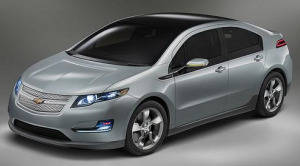
Style-wise, there is a lot of detail into some elements which adds a touch of sophistication, like the front turn signals, the taillights and the filled grille. The Volt definitely looks modern and drew a fair amount of attention, maybe because everyone knows about it by now. Six exterior colours will be available.
Charging the Volt with the provided 110-volt cable, in a standard home power outlet, takes 10 to 12 hours. You can also purchase a Voltec 240-volt charging stations for $490 USD, but you’ll have to get it installed, so it’ll cost more than that. With the higher-capacity outlet, the Volt can be fully recharged in 4 hours. Owners can remotely monitor their car by using the MyVolt.com website, and can set up a charge schedule or publish the car’s data onto Facebook, or by downloading a mobile application for their smartphone.
Pricing has not yet been set for Canada, as we won’t get the Volt until spring or summer of 2011. In the U.S., the Volt starts out at $41,000, which sounds mighty expensive for a compact-size sedan, albeit a nicely equipped one, and there will be a $7,500 federal tax break. GM is offering 36-month leasing for $350 a month with a $2,500 down payment, and if you figure that you won’t be putting in much gas, the car could pay for itself. Leather seats cost $1,395, a rearview camera and park assist cost $695 and polished alloy wheels cost $595.
We are impressed at how seamless the powertrain does its job. Besides the quietness of the drive in electric mode, the Volt behaves pretty much like a normal car, and that’s important if GM wants to sell it to normal people. They’ve done it. They’ve delivered on their promise. All that’s missing is customers who are willing to buy it, but GM expects to sell 45,000 of them annually in the U.S. by 2012. God Bless America.
The Volt’s cockpit has the dimensions of a compact car, and compared to a Cruze, it offers slightly less headroom, a little more shoulder room, and somewhat less rear-seat legroom. By the way, the Volt has two separate rear seats, no bench; the battery pack needs that space down the middle. Cargo room is rated at 300 litres with the rear seats up, but they can be folded down. Outward visibility is restricted by the fat A-pillars and the high rear hatch.
Style-wise, there is a lot of detail into some elements which adds a touch of sophistication, like the front turn signals, the taillights and the filled grille. The Volt definitely looks modern and drew a fair amount of attention, maybe because everyone knows about it by now. Six exterior colours will be available.
 |
| With the higher-capacity outlet, the Volt can be fully recharged in 4 hours. (Photo: Michel Deslauriers/Auto123.com) |
Charging the Volt with the provided 110-volt cable, in a standard home power outlet, takes 10 to 12 hours. You can also purchase a Voltec 240-volt charging stations for $490 USD, but you’ll have to get it installed, so it’ll cost more than that. With the higher-capacity outlet, the Volt can be fully recharged in 4 hours. Owners can remotely monitor their car by using the MyVolt.com website, and can set up a charge schedule or publish the car’s data onto Facebook, or by downloading a mobile application for their smartphone.
Pricing has not yet been set for Canada, as we won’t get the Volt until spring or summer of 2011. In the U.S., the Volt starts out at $41,000, which sounds mighty expensive for a compact-size sedan, albeit a nicely equipped one, and there will be a $7,500 federal tax break. GM is offering 36-month leasing for $350 a month with a $2,500 down payment, and if you figure that you won’t be putting in much gas, the car could pay for itself. Leather seats cost $1,395, a rearview camera and park assist cost $695 and polished alloy wheels cost $595.
We are impressed at how seamless the powertrain does its job. Besides the quietness of the drive in electric mode, the Volt behaves pretty much like a normal car, and that’s important if GM wants to sell it to normal people. They’ve done it. They’ve delivered on their promise. All that’s missing is customers who are willing to buy it, but GM expects to sell 45,000 of them annually in the U.S. by 2012. God Bless America.


Article Gallery