





On the road, you can feel the Terrain’s heft. On the other hand, the SUV is rock stable, the electric-assist power steering offers good feel and at 100 km/h, the engine spins at just under 2,000 rpm, which is good for both fuel economy and for hushing its somewhat-raucous sound at higher revs.
Over the years, domestic manufacturers have vastly improved the quality of their vehicle’s interiors, and it shows in the Terrain. There are still some cheap touches to be found, like the chromed plastic surrounding the shift lever, instrument pod and cupholders, the flimsy feel of the dashtop-mounted storage bin cover as well as the jagged edges inside the door-pull handles.
Yet the design is appealing, with silver-painted trim contrasting the black dash and stitched vinyl trim found in several areas. The wheel has a firm grip to it and the switchgear feels much more solid than what GM produced just 2 years ago. The audio system boasts a quality sound, despite that its button array takes some getting used to and the monochrome display looks archaic. A rear view camera is standard in all models, which is a good-to-have feature.
The premium cloth-covered seats, available from the SLE-2 trim up, include red contrast stitching and are both attractive and supportive. The rear bench slides fore and aft, its seatback angle is adjustable and legroom is among the best in its category; if there’s one aspect where the Terrain’s exterior dimensions pay off, this is it.
The Terrain also benefits from a good amount of cargo space; with the rear seat folded down, its 1,809-litre capacity is beaten only by a few other compact SUVs, namely the Honda CR-V and Toyota RAV4. It isn’t very wide back there, however, so make sure the baby stroller fits before signing the sales contract.
GM vehicles aren’t the bargains they used to be, and yet, their overall improvement in recent years doesn’t mean they have to be blue-light specials, either.
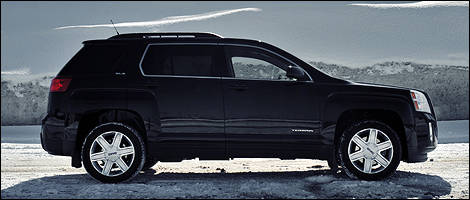 |
| Our average of 9.7 L/100 km during the test is very good. (Photo: Matthieu Lambert/Auto123.com) |
Over the years, domestic manufacturers have vastly improved the quality of their vehicle’s interiors, and it shows in the Terrain. There are still some cheap touches to be found, like the chromed plastic surrounding the shift lever, instrument pod and cupholders, the flimsy feel of the dashtop-mounted storage bin cover as well as the jagged edges inside the door-pull handles.
Yet the design is appealing, with silver-painted trim contrasting the black dash and stitched vinyl trim found in several areas. The wheel has a firm grip to it and the switchgear feels much more solid than what GM produced just 2 years ago. The audio system boasts a quality sound, despite that its button array takes some getting used to and the monochrome display looks archaic. A rear view camera is standard in all models, which is a good-to-have feature.
The premium cloth-covered seats, available from the SLE-2 trim up, include red contrast stitching and are both attractive and supportive. The rear bench slides fore and aft, its seatback angle is adjustable and legroom is among the best in its category; if there’s one aspect where the Terrain’s exterior dimensions pay off, this is it.
The Terrain also benefits from a good amount of cargo space; with the rear seat folded down, its 1,809-litre capacity is beaten only by a few other compact SUVs, namely the Honda CR-V and Toyota RAV4. It isn’t very wide back there, however, so make sure the baby stroller fits before signing the sales contract.
GM vehicles aren’t the bargains they used to be, and yet, their overall improvement in recent years doesn’t mean they have to be blue-light specials, either.
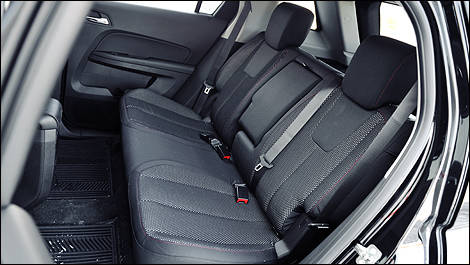 |
| Rear-seat legroom is among the best of the compact SUV segment. (Photo: Matthieu Lambert/Auto123.com) |