





Slightly different over here
The North American i-MiEV will be slightly different from the Japanese model that we tried out in Montreal. According to Mitsubishi Canada’s Product and Pricing Manager, Don Ulmer, minor changes to the bodywork will be necessary to comply with local safety requirements. The bumpers will be revised and the interior will expand slightly, he says. Also, our variant will incorporate a full assortment of airbags (which our 1,080-kilo tester didn’t have).
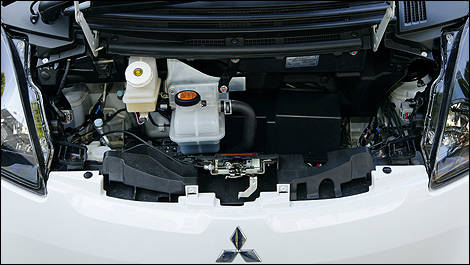
These modifications won’t alter the fundamental architecture of the car, however. The 43-kW (63-hp) electric motor finds itself right in front of the rear (driving) axle, next to a converter, a charger and other drivetrain components.
The 330-volt lithium-ion battery is located under the floor, which lowers the car’s center of gravity and contributes to more pleasant, more predictable handling.
Fun to drive… and quiet!
The Mitsubishi i-MiEV drives like a regular automobile, except that it doesn’t make any noise — unless, of course, you count the barely-audible friction between the tires and the road. The car is so quiet, in fact, that the North American model will feature a noise generator to alert unsuspecting pedestrians. "I’m hoping for a customizable system," says Mr. Ulmer.
Who knows? Maybe music lovers will be able to let other road users hear their favorite tunes as they announce their presence. "Watch out! Here comes another AC/DC!"
If said road users don’t share the same tastes in music, they won’t have to bother for very long. With 133 lb-ft of torque almost instantly accessible when you depress the throttle, this miniature Mitsubishi can zip past traffic in a hurry!
Sadly, our test drive on Circuit Gilles-Villeneuve was limited to speeds of 30 km/h. And to think F1 cars light up the very same tarmac at more than 200 km/h. What a shame! The total absence of patrol officers did allow me to cheat my way to about 65 km/h, which gave me the assurance that the average driver will manage to feel at home on the open road but more so in urban streets.
The North American i-MiEV will be slightly different from the Japanese model that we tried out in Montreal. According to Mitsubishi Canada’s Product and Pricing Manager, Don Ulmer, minor changes to the bodywork will be necessary to comply with local safety requirements. The bumpers will be revised and the interior will expand slightly, he says. Also, our variant will incorporate a full assortment of airbags (which our 1,080-kilo tester didn’t have).
 |
| The i-MiEV delivers linear accelerations from 0 to 100 km/h in 13 seconds, which proves fast enough for a city-oriented microcar. (Photo: Mitsubishi) |
These modifications won’t alter the fundamental architecture of the car, however. The 43-kW (63-hp) electric motor finds itself right in front of the rear (driving) axle, next to a converter, a charger and other drivetrain components.
The 330-volt lithium-ion battery is located under the floor, which lowers the car’s center of gravity and contributes to more pleasant, more predictable handling.
Fun to drive… and quiet!
The Mitsubishi i-MiEV drives like a regular automobile, except that it doesn’t make any noise — unless, of course, you count the barely-audible friction between the tires and the road. The car is so quiet, in fact, that the North American model will feature a noise generator to alert unsuspecting pedestrians. "I’m hoping for a customizable system," says Mr. Ulmer.
Who knows? Maybe music lovers will be able to let other road users hear their favorite tunes as they announce their presence. "Watch out! Here comes another AC/DC!"
If said road users don’t share the same tastes in music, they won’t have to bother for very long. With 133 lb-ft of torque almost instantly accessible when you depress the throttle, this miniature Mitsubishi can zip past traffic in a hurry!
Sadly, our test drive on Circuit Gilles-Villeneuve was limited to speeds of 30 km/h. And to think F1 cars light up the very same tarmac at more than 200 km/h. What a shame! The total absence of patrol officers did allow me to cheat my way to about 65 km/h, which gave me the assurance that the average driver will manage to feel at home on the open road but more so in urban streets.
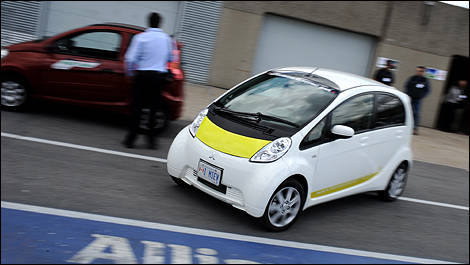 |
| The car’s build quality favorably compares to a Lancer or Outlander. (Photo: Matthieu Lambert/Auto123.com) |